
Lagavulin 16 year old

16 years old, 43% ABV, Islay, Scotland

My first encounter with the Lagavulin 16 year old was at the end of a memorable meal at a great little Spanish restaurant called MoVida.

A week went by and I couldn’t shake the thought of that intriguingly smokey-sweet dram I’d had, so I soon found myself at a local bottle shop purchasing my first Islay whisky.
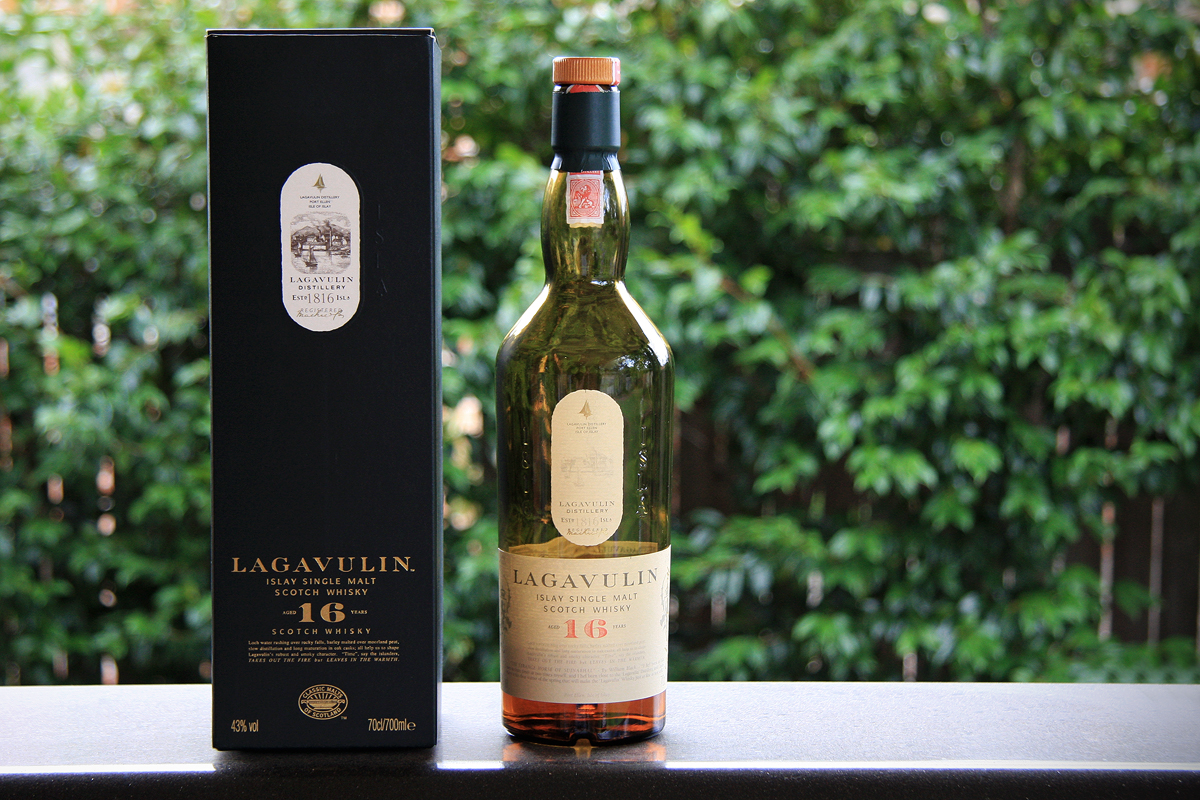
Lagavulin 16

Although the Lagavulin bottle shape is shared with a number of Diageo’s other single malts (such as Caol Ila, Talisker, Cragganmore and Royal Lochnager), the green tinted glass and two-piece parchment style label go a long way to making it stand out as unique.

Lagavulin 16 closure

After peeling back the foil there’s a seal over the top of the cork which is a nice touch – a hangover from the pre-foil days I suspect. I’ve contacted Lagavulin to try and find out the significance of this little lion character, but have had no luck as of yet.

Did you know… 

The barley used for Lagavulin is produced at Port Ellen Maltings.

A common misconception is that the germinating barley is dried over a peat fire. At Port Ellen Maltings the barley is dried using hot air produced by oil burners and the peat fire underneath the kiln is only there to impart the smokiness we associate with some of the great Islay whiskies.

If you’ve got 10 minutes to spare, this great video gives you a behind the scenes look at Port Ellen Maltings.

Nose 

Waves of organic peat smoke – Think salty smoke notes, with ash and some sweetness. There’s a really nice balance between the three S’s – smoke, sweetness and salt – with none of the three completely dominating the nose.

Friends and family have used terms like ‘industrial, old oil lamp and mechanics workshop’ to describe the nose on this! Probably not far off, but it’s much more refined and alluring than those terms suggest.

Palate 

Initially quite oily with some sweetness at the front of the tongue. This is followed by a wave of salty saline notes, peat or ash and some warm prickling, not necessarily from the alcohol though. I almost feel as though it’s the kind of tongue prickling burn you get from something heavily cured or brined.

Finish

Residual sweetness, really light menthol notes and waves of peat smoke every time you exhale. That wonderful peat smoke fades to lingering salty finish with some faint bitter notes.

Overall 

A newly opened Lagavulin 16 hits you with waves and waves of smoke, fresh out of the bottle. I found that pure smoky magic faded rather quickly once the bottle had been opened for a few months, but at the same time it has matured a fair amount and has a lovely balance to it.

Make no mistake, you can still smell this one from the coffee table once you’ve poured a dram and sat back in your chair!

Glenfarclas 15 year old

15 years old, 46% ABV, ex-Oloroso & Fino Spanish Oak casks, Highlands, Scotland 

The Whisky Exchange in London have recently voted the Glenfarclas 15 their whisky of the year, so I thought I’d explore my experience with this sherry bomb.

Glenfarclas 15

The presentation is pretty straightforward and classic. The burgundy, cream and red colours are accented by some copper-foil on the label and tin. It’s a pretty rich and regal colour palette, but then so too is the whisky, so it’s rather fitting!

Glenfarclas tin

Nice copper coloured tin closures with the intertwined J&G Grant logo, which is also repeated on the back label.

Glenfarclas label

I really like the simplicity of this line drawing of the distillery.

These notes were after the bottle had been opened for a good ten months or so, sitting at about half full.

Nose

Rich raisin notes with a hint of sourness – almost reminds me of tarty grapes or even kiwi fruit. Also had some cinnamon spice notes mixed in with the spiciness from the 46% alcohol content. I didn’t find the nose overly sweet, but there was a slight toffee/vanilla/oak note in there somewhere and a hint of wood smoke.

A very rich nose on this one after seven months and if I didn’t know what it was, I would have guessed it was older than 15 years.

Palate

Initially fairly oily before it gives way to rich fruit sweetness. I didn’t find it sweet in sugary sense of the word, but more like a natural stewed fruit kind of sweetness, with hints of charcoal. This is followed by some cinnamon/oak spice notes that linger in a tongue tingling kind of way.

Finish

The spice tingle continues with waves of long-lasting warmth down to the top of your chest, leaving you with a buttery/creamy mouth. After a good few minutes I also got some faint oaky bitterness, almost like a bitter almond note and some really faint residual wood smoke.

Comments

After trying a sherry oak Macallan and falling in love with it, I immediately went out in search of other heavily sherried whiskies. One popped up time and time again on various forums and that was the Glenfarclas 15year old. Without hesitation I tracked down a bottle and bought it.

At the time, I just thought ‘well Macallan is heavily sherried and the interwebz tells me that Glenfarclas is heavily sherried, so they must be the same! Awesome.’

When I got around to opening the Glenfarclas, I almost felt let down. ‘Where’s all that toffee sherry sweetness!?’ I tried to get into it a few more times over the coming weeks, but ultimately stashed in the back of the cabinet and left it for a good six months. In that time, the bottle really opened up – but more than that – so too did my understanding of sherried whiskies and whisky in general.

They were a similar age, both ex-sherry cask and both from a similar region in Scotland. But in a way, that’s where the similarities ended for me. Where the Macallan was lighter, toffee sweet and smooth, the Glenfarclas was big, rich and more complex, with hearty fruit and oak notes and a hint of warming spice.

I still love the Macallan, but I also love this, for very different reasons. One of those reasons being that the Glenfarclas was one of the first whiskies to really open my eyes to the vastly different flavour profiles out there and complexity that can be found in a whisky. This is a go-to winter whisky for me and now that my bottle is empty, I can definitely see it be replaced by another ‘farclas before too long.