Glendronach 1994 single cask

Batch 9, Distilled 1994, 19 years old, Cask No. 3385, 53.4% ABV, Pedro Ximenez Sherry Puncheon, Speyside, Scotland

If you’re into heavily sherried whiskies, there’s a good chance you’ve heard of Glendronach. Their regular core range is pretty top-notch, consisting of four different offerings ranging in age from 12 through to 21 years.

The bottle being tasted isn’t actually part of their core range though. It’s part of their semi-annual limited release of ‘single cask’ expressions, which are bottled at natural cask strength. You don’t see these too often in Australia, so when a friend suggested I review his bottle, I wasn’t exactly going to say no!

Glendronach 1994

Look at that colour! It’s like treacle or golden syrup! I don’t know about you, but when I see a whisky that colour – and when I know that it’s natural colour – I get pretty damn excited.

Glendronach 1994 - Copper

The presentation of these bottles is pretty special – rich metallic brown packaging scribed in copper coloured lettering. The box is also lined in a sand colour suede-like material. You feel a real sense of occasion when you pick up and open the box on one of these.

Glendronach 1994 - NCF

Apart from being bottled at cask strength, all of Glendronach’s single cask releases are non-chill filtered (NCF) and bottled at their natural colour – something they’re quite proud of. This is as close as many of us will come to drinking straight out of a cask!

Glendronach 1994 - Label

This particular bottle is from batch 9 of their single cask releases. Distilled in 1994 and matured in a Pedro Ximenez Sherry Puncheon – one of the larger casks used in the whisky industry at around 500 litres in size.

Did you know…

When this particular batch of whisky was distilled in 1994, Glendronach still floor malted their own barley (instead of buying malted barley in from somewhere else).

As part of the malting process, they dried their barley over a coal and peat fuelled fire, resulting in a spirit that was peated to around 14 parts per million (PPM). This is nowhere near the ~55-60 PPM of something like an Ardbeg 10 year old, but it’s still pretty peaty for a Speyside whisky!

Nose

Immediately I got classic sweet PX sherry with some tarty notes in there – almost like tarty raisins or apricots.  Sniffing it again (and this might sound a bit crazy), I was reminded of caramelized peaches – you know, when you cut one in half, sprinkle brown sugar on it, add a knob of butter then put it under the grill in your oven. Lovely rich caramelized sugar and fruit notes, with a hint of burnt spice. A really deep nose that you can sniff and sniff and sniff.

If you leave this to sit for a good while in the glass it really opens up and the brown sugar raisin notes really come to the front quite nicely.

Palate

The first thing you notice is how thick, syrupy and tongue coating it is. Just brilliant. Sweet dried raisins, hint of spice, slight oakiness and a really faint sour fruit note – maybe orange marmalade? All of the flavours are really complimentary – no single one jumps out sharply at you.

Finish

The finish is long and warming, not fierce at all, a real winter chest warmer – which is kind of ironic considering I tried it on a 40 degree (104F) summer day in Sydney! Fruity sweetness eventually fades and some of the tannic oak starts to show through after a good few minutes.

Comments

Even though this is bottled at 53.4%, it’s incredibly drinkable and that extra few percent – combined with the non-chill filtering – really locks in a huge amount of flavour.

When I see that kind of ABV, I often consider adding a few drops of water, but I don’t think this needed any all. I did test it out, but I personally think it lost some of its magic. A bit of patience and some glass time is all this one needed to really shine.

The Glenlivet 12 year old

12 years old, 40% ABV, American and European Oak, Speyside, Scotland

When I was putting together my Christmas whisky tasting kits, I wanted to start everyone off with a really approachable, classic single malt – to provide them with something of a base line I suppose.

Realising I didn’t seem to have anything that met the criteria that well, I tracked down this little 200ml (20cl) bottle of The Glenlivet 12 year old. There happened to be a couple drams worth left after I’d put the kits together, so I thought I’d review it!

Glenlivet 12

Despite being a mini version, the bottle and label design holds true to the 700ml version of the 12 year old – just in miniature form.

Glenlivet 12 notes

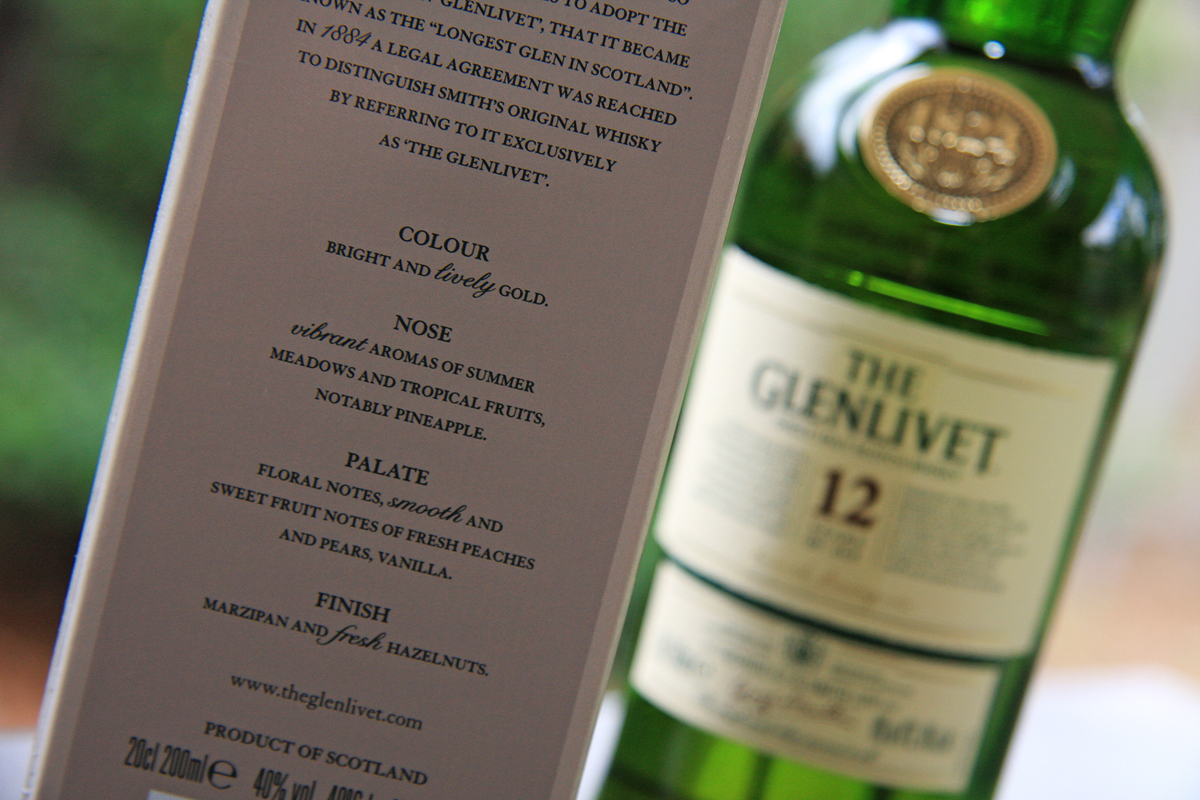
Just like the tasting notes found on the back of the 18 year old I reviewed a little earlier, there are some notes on the back of this mini box for the 12 year old. Again, I’m not sure I completely agree with all of them, but they are a nice touch and fun to compare to.

Did you  know…

In my review of the 18 year old, I mentioned that I was looking into the origins of The Glenlivet’s thistle motif. I reached out to some people that work at the distillery’s visitors centre and asked them about the origin of the thistle logo and it turns out that they’re not entirely sure why it’s there either! All I can tell you is that it appeared in the 1970’s and has been there ever since.

It does seem to be a common theme among many business names and logos in Moray (where the distillery is located), so perhaps there’s some connection there?

Nose

I got a big hit of green apples – but in an apple cider kind of way. Quite drying, with some citrus and a light sweetness.  The more I nosed this, the more I kept thinking that it reminded me of a sauvignon blanc – it’s a very delicate nose. When left to sit in the glass, the nose does sweeten up a bit and those crisp dry cider notes fall away a bit.

Palate

Quite thin feeling in the mouth, with sweet and citrusy notes immediately apparent. These were followed by some hints of vanilla and a bit of spicy bitterness – almost like citrus fruit pith.

Finish

Quite short, but also quite a pleasant finish. As the finish fades, I got some stronger vanilla notes (which were nice) and some oaky bitter spice at the front of the tongue, right towards the end.

Comments

This expression is matured in a mixture of cask types, including American and European Oak. It’s fairly one dimensional and not overly complex in flavour, but like all Glenlivet’s I’ve tasted, it’s a good quality, reliable whisky. A really pleasant, light, pre-dinner dram.

Bakery Hill Cask Strength Peated Malt

NAS, 60% ABV, American Oak, Victoria, Australia 

I recently exchanged a number of emails with the friendly and helpful people at Dram Fine Whiskies in Melbourne Australia. A week or so later I was genuinely excited when a small box arrived from them with a few samples of some great Australian single malts that I hadn’t tried – this Bakery Hill was one of them.

Bakery Hill

Bakery Hill distillery started in 1999 in Victoria, Australia. Fast forward 14 or 15 years and they now produce six or seven different single malt whiskies, along with a Vodka and a Gin.

Did you know… 

Bakery Hill originally tested out their peated malt whisky using imported malt from the UK, before switching to Australian peated malt in 2005.

Nose 

Big sweet alcohol spirit nose.  You know it’s cask strength, but it’s still somehow soft and a bit mild.  I get hints of malty cereal notes and really soft peat in the background.

Add a few drops of water and the nose really opens up with some light creamy vanilla notes, sweet oak and light peat smoke.  Much better!

Palate

A big smack in the mouth of oily, viscous spicy sweetness. Really light fruit notes – almost a bit sour – hints of smoke, spice and oak.

Some water brings out a nice creamy sweetness and highlights those fruit notes a bit more. It also allows the peat to show through, bringing with it a somewhat drying nutty oaky-ness.

Finish

Wave after wave of warmth (really though, that’s kind of what you expect for a 60% ABV heavy weight) The warmth gives way to some earthy drying peat notes.

Water tames the finish, only ever so slightly though. Warming spice, earthy peat and a slight dark cocoa/oak bitterness right at the back.

Comments

When I saw the words ‘peated malt’ I was expecting something a lot more in your face, but this was somewhat delicate, especially as far as the peat is concerned.

I could be wrong, but I’m guessing this batch is post 2005 (when they started using Australian peat). It seems to have a drying earthiness to it, similar to a Speyside peated whisky, like a peated BenRiach. It’s quite different to the Isaly peat we’re most familiar with.

Some people like their cask strength whiskies neat (and some cask strengths actually taste better neat), but I think this one really benefits from a few drops of water – that’s when it really opened up for me. I suspect this is fairly young, but it’s got some great flavour going on, so I would love to see something older from Bakery Hill in the future!

A big thanks to Shaun from Dram Fine Whiskies in Melbourne for the sample.

The Glenlivet 18 year old

18 years old, 43% ABV, American & European Oak, Speyside, Scotland 

One of the first single malts I ever owned was The Glenlivet 18 year old. A few years back I had family travelling through London and they knew I had a thing for whisky. They kindly picked up a bottle for me, opting for something they’d heard of, so I was pretty chuffed when this arrived.

Glenlivet 18

One thing you note when you pick up this bottle is how solid it is. The box is made of sturdy matte-finished card and the bottle of heavy glass – complete with a thick base reminiscent of a quality whisky tumbler.

Glenlivet 18 box

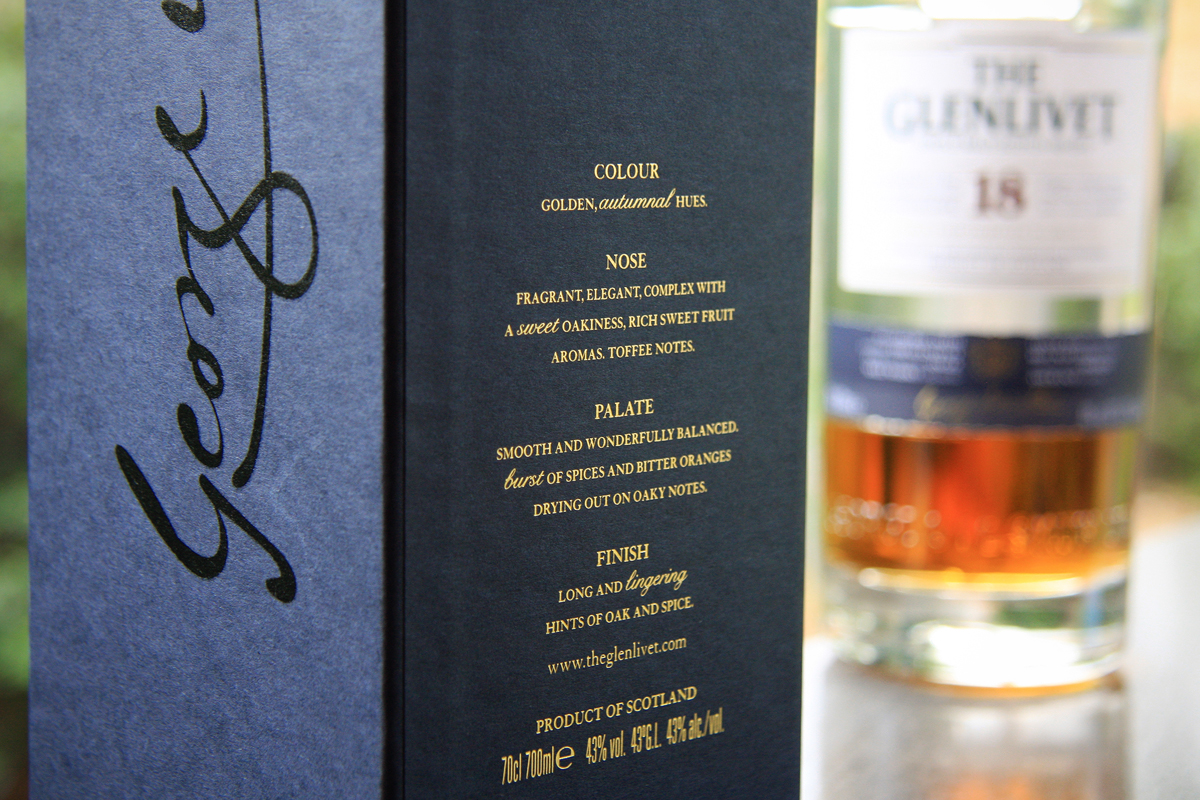
The rear of the box has a few paragraphs on the founding history of The Glenlivet (not shown), along with these tasting notes. I’m not sure I agree with all of the notes, but they’re a nice touch and it’s fun to have something to compare against.

Glenlivet thistle

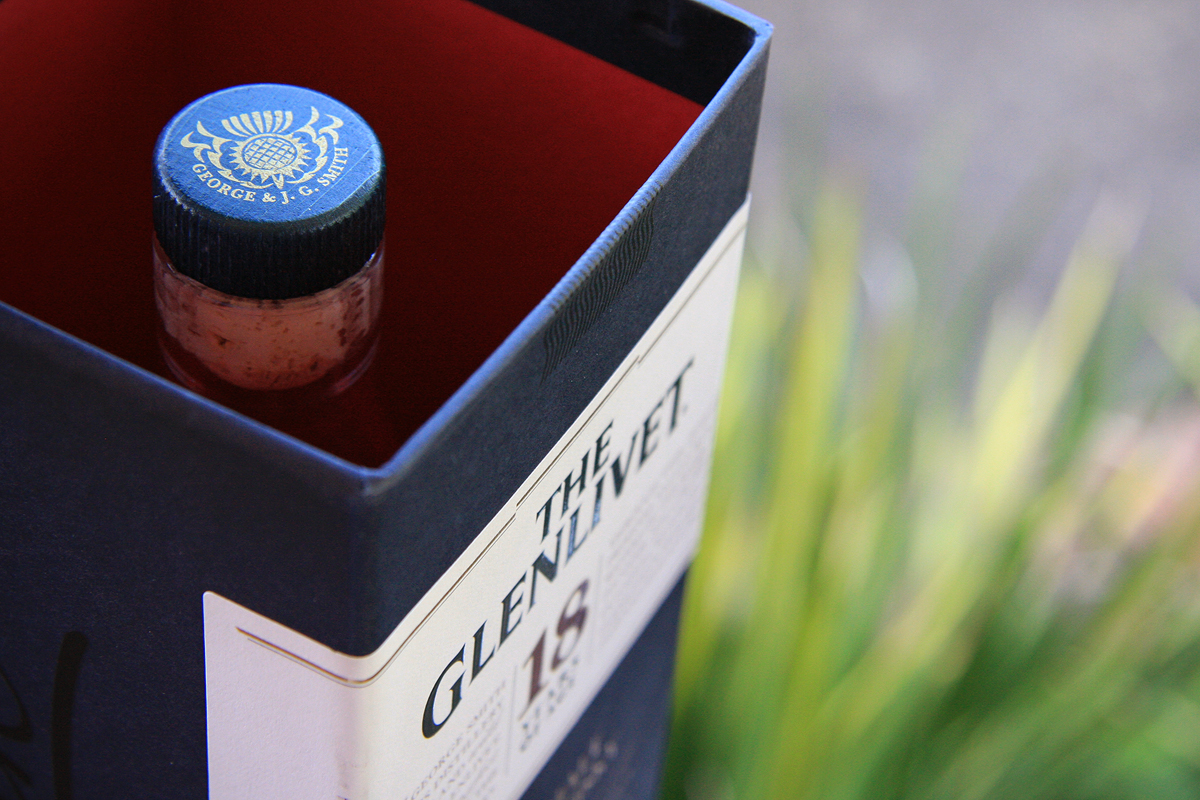
The Glenlivet thistle motif (I’m pretty sure it’s a thistle) can be found in numerous places on the bottle and packaging. I’ve contacted The Glenlivet to try and find out its significance, but nothing to report just yet.

Did you know… 

To protect their stocks from the risk of fire, The Glenlivet store their maturing casks – they currently have over 65,000 – in a number of different locations all over Scotland.

Nose 

Quite a soft nose with hints of apples, pears and really muted sherry notes. There are some floral notes hidden in there and traces of spice. I also get an intriguing sourness, almost like a sour apple candy or maybe apple cider vinegar.

After a good 15 to 20 minutes in the glass the nose shows some mildly sweet notes to go along with the sourness (reminds me of a Fino sherry).

Palate

Starts with an oily, tongue coating mouth feel of soft fruit sweetness which gives way to some spice. I got some bitter nutty notes in the background, almost like citrus peel and almonds. Quite a nice balance between sweet, sour and spice.

Finish

A mid length finish with some throat warmth, lingering creamy mouth feel (from the American Oak I suspect) and a drying oak bitterness with hints of spice.

Comments

After I received this bottle I went on to buy other things and so it remained unopened for quite a while. Looking back on it, that was probably a good thing as I don’t know I would have fully appreciated it straight away.

Despite the liquid amber-ish colour which suggests a noticeable sherry influence, I found The Glenlivet 18 year old to be a rather light and delicate whisky, with a surprisingly complex nose.

Lagavulin 16 year old

16 years old, 43% ABV, Islay, Scotland

My first encounter with the Lagavulin 16 year old was at the end of a memorable meal at a great little Spanish restaurant called MoVida.

A week went by and I couldn’t shake the thought of that intriguingly smokey-sweet dram I’d had, so I soon found myself at a local bottle shop purchasing my first Islay whisky.

Lagavulin 16

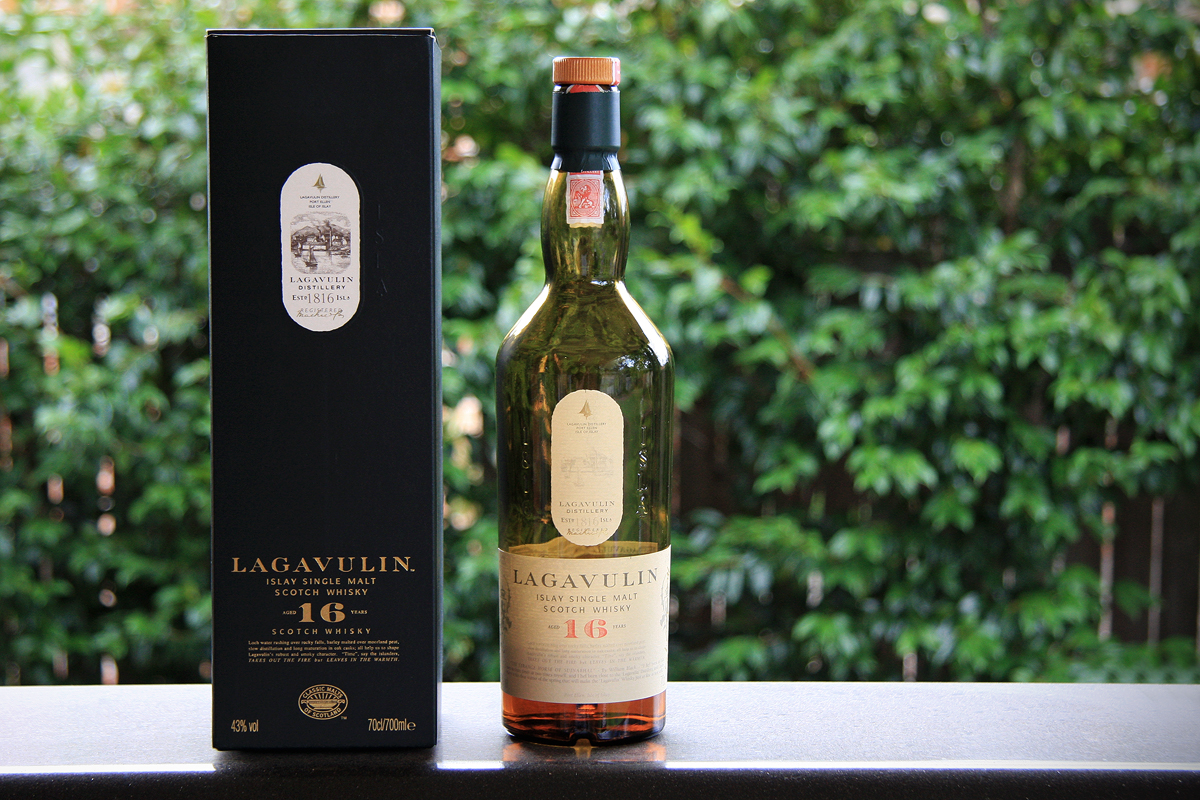
Although the Lagavulin bottle shape is shared with a number of Diageo’s other single malts (such as Caol Ila, Talisker, Cragganmore and Royal Lochnager), the green tinted glass and two-piece parchment style label go a long way to making it stand out as unique.

Lagavulin 16 closure

After peeling back the foil there’s a seal over the top of the cork which is a nice touch – a hangover from the pre-foil days I suspect. I’ve contacted Lagavulin to try and find out the significance of this little lion character, but have had no luck as of yet.

Did you know… 

The barley used for Lagavulin is produced at Port Ellen Maltings.

A common misconception is that the germinating barley is dried over a peat fire. At Port Ellen Maltings the barley is dried using hot air produced by oil burners and the peat fire underneath the kiln is only there to impart the smokiness we associate with some of the great Islay whiskies.

If you’ve got 10 minutes to spare, this great video gives you a behind the scenes look at Port Ellen Maltings.

Nose 

Waves of organic peat smoke – Think salty smoke notes, with ash and some sweetness. There’s a really nice balance between the three S’s – smoke, sweetness and salt – with none of the three completely dominating the nose.

Friends and family have used terms like ‘industrial, old oil lamp and mechanics workshop’ to describe the nose on this! Probably not far off, but it’s much more refined and alluring than those terms suggest.

Palate 

Initially quite oily with some sweetness at the front of the tongue. This is followed by a wave of salty saline notes, peat or ash and some warm prickling, not necessarily from the alcohol though. I almost feel as though it’s the kind of tongue prickling burn you get from something heavily cured or brined.

Finish

Residual sweetness, really light menthol notes and waves of peat smoke every time you exhale. That wonderful peat smoke fades to lingering salty finish with some faint bitter notes.

Overall 

A newly opened Lagavulin 16 hits you with waves and waves of smoke, fresh out of the bottle. I found that pure smoky magic faded rather quickly once the bottle had been opened for a few months, but at the same time it has matured a fair amount and has a lovely balance to it.

Make no mistake, you can still smell this one from the coffee table once you’ve poured a dram and sat back in your chair!