
Sampling some of Burn Stewart’s finest single malts at The Wild Rover, Sydney
Earlier this week I was fortunate enough to be invited to a rather special whisky masterclass hosted by a true stalwart of the whisky industry, Mr Ian MacMillan.
A long way from home, Ian was on his first-ever Australian visit to attend the Top Shelf boutique drinks festival down in Melbourne. But before making the 17,000-odd kilometer journey back to Scotland, he generously found some time in his schedule to host this great masterclass at The Wild Rover in Sydney’s Surry Hills (keep an eye out for a post on this very cool bar shortly!)

I refer to Ian as a true stalwart as he entered the whisky industry at the age of 18, starting his career at the Glengoyne distillery back in 1973. Over the following 40 years, Ian worked his way through numerous distilleries, from the ground up. He proudly tells us that he’s one of few in the industry today who can honestly say that they’ve ‘worked every single job in a distillery’.
It’s this kind of dedication that’s lead him to where he is today, as Head of Distilleries and Master Blender for Burn Stewart Distillers. Even if you haven’t heard of Burn Stewart, you’ve probably heard of their single malts – Deasnton, Bunnahabhain and Tobermory.
On with the drams then!
I would have been pretty happy to just listen to Ian’s fascinating stories all afternoon, but we were at The Wild Rover to taste some whisky – and taste whisky we did.

Before I launch into these though, it’d be remiss of me to not mention something about Ian’s whisky making philosophy. You see, he took great pride in explaining that when it comes to whisky making, he considers himself a ‘pure traditionalist’.
Among other things, he made a particular point of recognising the role that people play in making the whiskies in the Burn Stewart portfolio. ‘The people working at these distilleries have such pride and are so proud of what they make … tell me of any computer panel that has that kind of passion for making liquid’.
It’s also worth pointing out that all four of the single malts we tried were non-chill filtered, natural colour and bottled at a generously enjoyable 46.3% ABV.

Ian’s reasoning behind non-chill filtering was a pretty good one too.. ‘we’d been making whisky for 800-odd years before chill filtration was invented and there was bugger-all wrong with it back then’ – so why do it now? Classic.
I found his whole approach pretty admirable and after hearing what Ian had to say, I couldn’t help but feel like it added a little something special to the four whiskies we were about to taste.
Deanston 12 year old
First cab off the rank was a whisky that I’d heard of, but never tasted – Deanston 12 year old. From Perthshire in the Central Highlands region, Deanston was opened in 1966 in an old cotton mill.
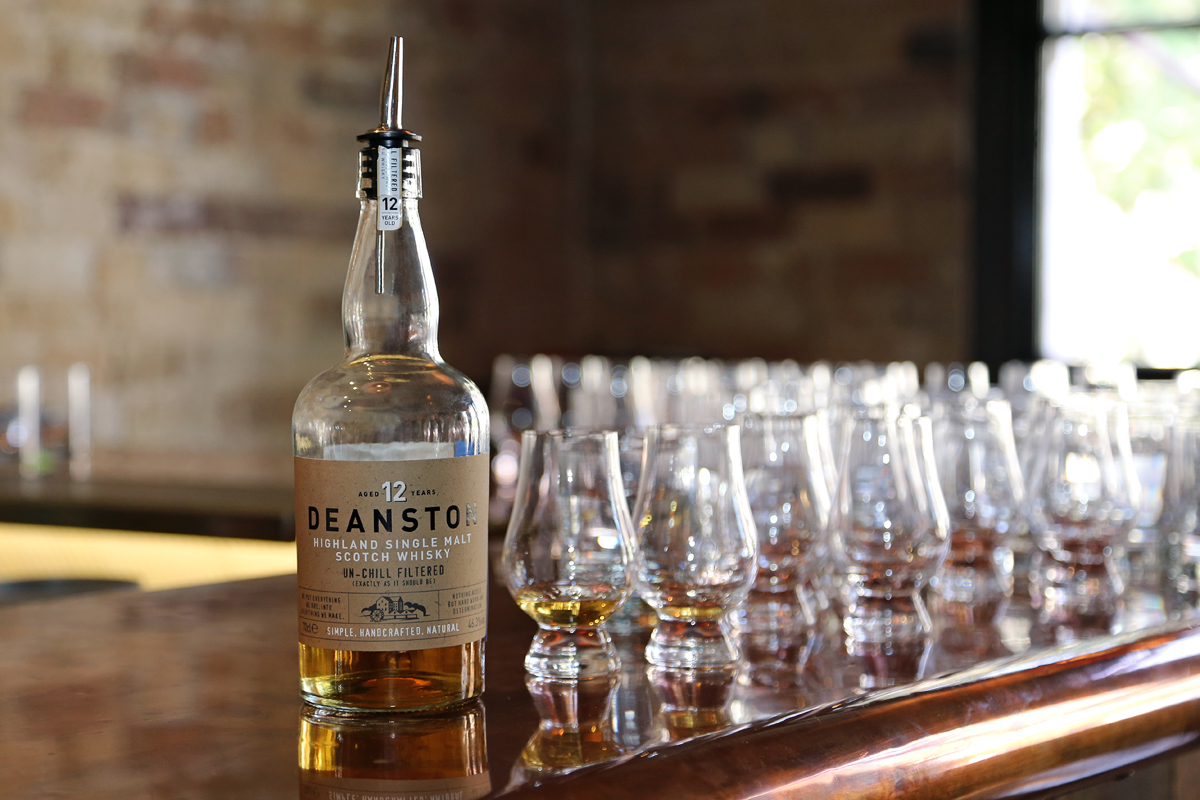
Ian reckon’s it’s the most honey-influenced malt you’ll find. I always thought The Balvenie would hold that crown, but after tasting it, he could indeed be right!
Matured solely in ex-bourbon American Oak casks, I got some big honey notes on the nose, with hints of a citrus-tang, sweetness, orange zest and vanilla. This translated rather nicely to the creamy, oily palate with fresh zesty citrus notes and honeycomb sweetness finishing with some light spice.
Bunnahabhain 12 year old
For those of you who haven’t encountered Bunnahabhain before, it’s produced on the isle of Islay, but unlike some of its heavily peated brethren, Bunnahabhain’s core range is actually un-peated (well, that’s a little lie, it’s peated to around 2 – 3 parts per million – but that’s almost nothing).

Around 40% of the content in the 12 year old is matured in first-fill ex-Oloroso sherry casks, so you get some wonderful nutty raisin notes mixed in with some light zesty fruit, sweet cured meat (well, that’s what I was reminded of anyway!) and the faintest whiff of smoke.
The intriguing nose is followed by a lovely viscous palate that nicely balances sweet and salty elements, fruit and really mild peat, finishing with a briny/salty tang. I’ve got a bit of a soft spot for this one.
Tobermory 15 year old
You’ll find Tobermory off the west-coast of Scotland on the Isle of Mull where they’ve officially been distilling since 1798. I say ‘official’, as records show that they actually started some 300 years earlier, back in the 15th century!

Quite a unique, heavy nose on this. I got hints of roasted coffee, dark chocolate, dark fruits and a faint salty/tangy note. Looking back over my notes, I think I wrote the word ‘rich’ about three times without realizing it.
As with the other two, another lovely oily mouth-feel on the Tobermory. Flavour wise, I couldn’t help but be reminded of fruit and nut chocolate, fruity sherry (minus the sweetness) and a slight tang, all giving way to a long warming finish.
Ledaig 10 year old
Ah Ledaig. Looks simple to pronounce – Lé day-g – but if you, like me, thought that’s how it’s pronounced, then you’d be wrong. Ian tells us it’s pronounced something like ‘Lech-igg’ or ‘Led-chigg’. Got to love Gaelic.
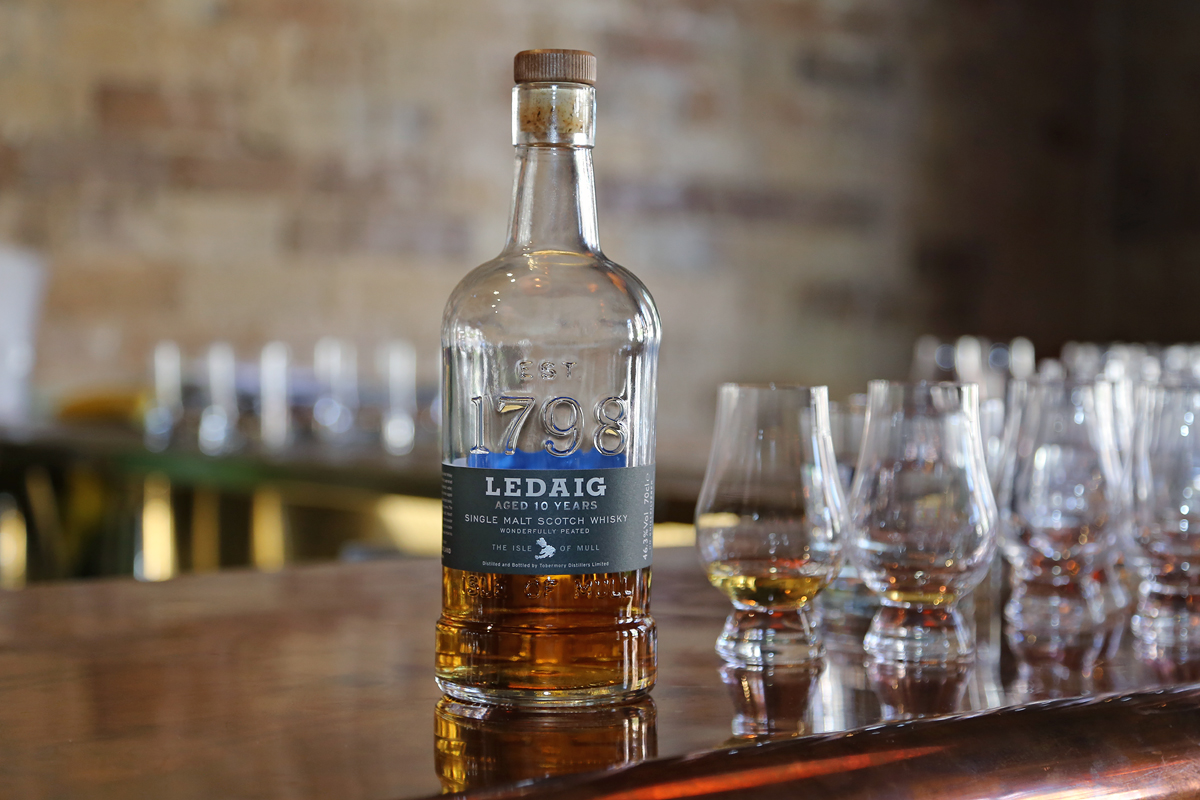
Produced at Tobermory, Ian informs us that with Ledaig, he set out to produce a whisky that was similar in characteristic to what would have originally been produced at Tobermory.
On the nose, the Ledaig 10 year old has light, warming wood-smoke honey notes. This translates nicely to an oily palate and a warming finish, with hints of citrus that turn rather drying after a short while.
Some final thoughts
The masterclass drew a crowd predominantly made up of industry and bar staff from all over Sydney, but there also happened to be two of Sydney’s finest drinks bloggers in the room – Corinne from Gourmantic and Matt from Distant Thunder Whisky Club – two fellow whisky fans whose sites are well worth the read. It was a real pleasure meeting you both!
I don’t know about everyone else in the room, but I already had a bit of a soft spot for Bunnahabhain and Tobermory. After hearing more about them, I feel as though these are a couple of quality, underrated whiskies that drink a fair bit higher than they’re often scored. I’d definitely keep an eye out for these behind your favourite bar if you’re looking to try something new.
A sincere thanks to Ian MacMillan for his time and to the folks at Island2Island Beverage Company for brining him out to Australia. I genuinely hope we get to see more of him, and his whiskies, in the near future.


 The Whisky Ledger