Ardbeg Day – The Whisky

Released 2 June 2012, 56.7% ABV

To set the scene for these next few posts, each year during the Feis Ile festivities on the isle of Islay, Ardbeg have been known to release a special, limited production bottling to commemorate the celebrations.

Historically, these highly sought after bottles were only ever available to the dedicated Ardbeggians who queued up outside the distillery, but this changed in 2012. For the first time, Ardbeg made their famous Feis Ile bottling available worldwide via official ‘Ardbeg Embassies’ and coincided its release with the newly established Ardbeg Day.

What should one name the inaugural release? Ardbeg Day of course!

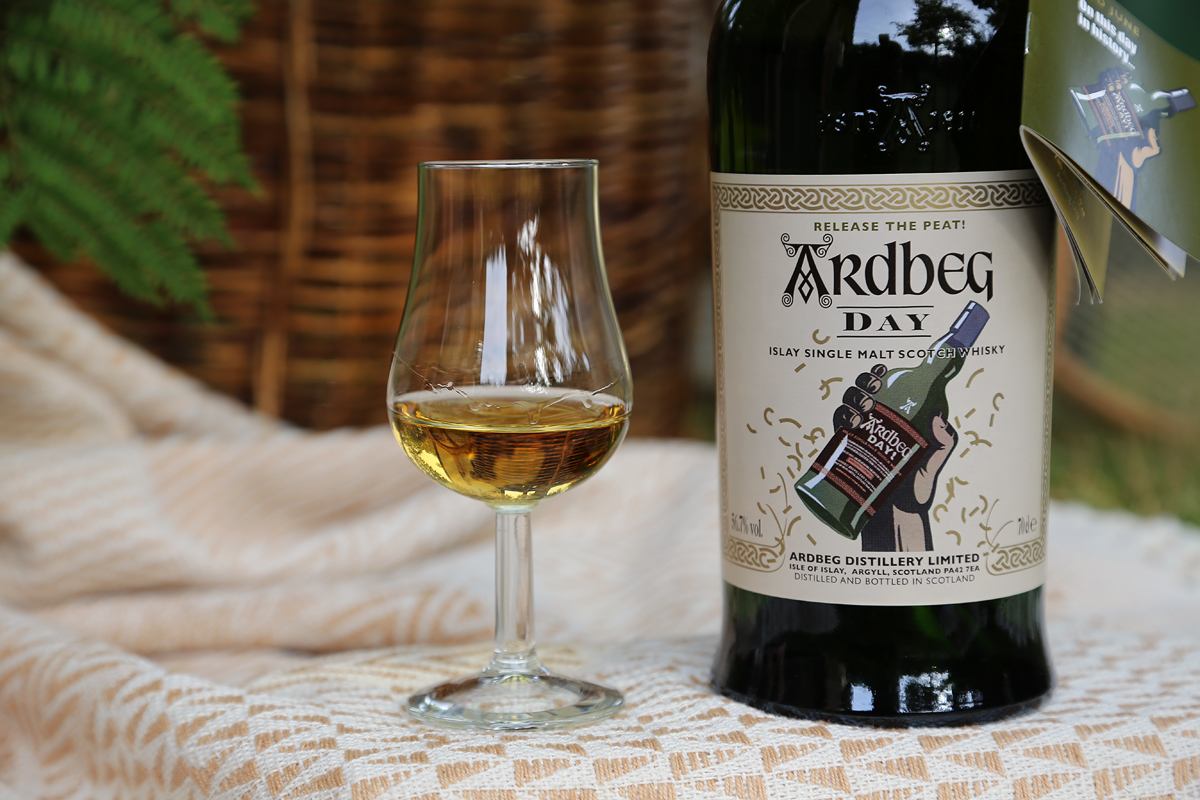
Ardbeg Day - Bottle

According to the label details, Ardbeg Day is a composition of two different expressions, finished in refill sherry casks (since said to have been ex-Uigeadail casks) and was bottled at a hefty 56.7% ABV. I’ve heard that it was limited to 12,000 bottles worldwide, but I’m yet to find any official documentation of that.

The bottle was released as bottle and swing tag only and was never presented in standard box packaging. The little swing tag booklet has some pretty quirky illustrations in it covering random historical events that ‘took place’ on the 2nd of June in years gone by

Ardbeg Day - Swing tag

There’s a sneaky footnote in the booklet though which read: ‘Ardbeg takes no responsibility for any factual inaccuracies, satisfied that the historical occurrences herein contain at least a grain of truth’.. cheeky! One we can rely on though is this

Ardbeg Day - Swing tag 2

The Ardbeg Day whisky was only available from 2 June 2012 through official Ardbeg Embassies and as you may have guessed, it sold out pretty quickly.

Ardbeg Day - Glass

Nose

Initially I found this to be quite vibrant and fresh – zesty peat right up front, some vanilla, perhaps a touch of ginger, molten sugar sweetness, some crisp hints of fruit and quite a wallop of a mineral/salty saline note. Overall, I’d describe this as quite a dry nose.

Palate

Really quite oily and viscous from the get go. Fiery, spicy and heavy on the zesty, earthy, saline peat notes right up front on the tongue. These seem to almost intensify, but I also get a hint of vanilla, some ashy coal and smoke. Not a whole of sweetness with this one, though it does show its head after a good half hour in the glass.

Finish

The peat and saline notes really intensified for me on the finish, resulting in a greatly satisfying, long, chest-warming finish. As the finish fades, still quite dry and spicy.

Comments

I found all of the aromas and flavours on both the nose and palate to be quite pointed, sharp and pronounced. To me, there’s nothing rounded or shy about this one. It tasted quite youthful, vibrant and bitey and I’d describe it as one of the more intense Ardbegs I’ve tasted.

My personal preference would be to tame this with a drop or two of water (and it seems to hold that amount of water quite well) though I do actually quite enjoy the drying intensity of it.

Two years down since its release and I still really enjoy this one, though I can’t confidently liken it to anything else that’s currently available in Ardbeg’s core range (as of 2014). It’s not totally dissimilar to Ardbeg Alligator, though that’s a bit of an unhelpful comparison as they both now command collector (as opposed to drinker) prices.

Very pleased to have been able to re-taste this one from a sample. Next up, the 2013 Ardbeg Day release – Ardbog.

Sipsmith VJOP

Gin – on a whisky blog?! What’s this un-aged spirit doing on here! Well, whisky may be my one true malty love, but I’ll always have room for a good gin, especially on a warmer than average Easter long weekend, like the one we just had.

For the diehard whisky fans out there, don’t tune out just yet – there’s an interesting little whisky connection in all of this, I promise!

And so we met

Sipsmith was established in the West London area of Hammersmith back in 2009 and so became the first copper-pot distillery to open in London in more than 189 years.

I first became acquainted with them in early 2012 after stumbling upon their London dry gin one evening at Sydney bar. I knew nothing about it at the time, but that first taste was enough for me to realise I was drinking something a little different. And I liked it!

Sipsmith Jubilee

A few months later this commemorative Diamond Jubilee bottle landed in my hands courtesy of a family member returning from the UK. I didn’t have the heart to crack it open at the time, but thankfully I didn’t need to as Sipsmith London Dry was launched nationwide shortly thereafter.

The launch coincided with a visit from one of the founding Sipsmiths – the ever charismatic Mr Sam Galsworthy – and I had the genuine pleasure of meeting him and hearing all about Sipsmith, Prudence and the gang first hand. It’s fair to say that they’ve had a Sipsmith fan in me ever since.

Things went a little quiet on the Sipsmith front, but when I saw that they’d recently released the equivalent of a cask-strength gin, I knew I had to try it.

Sipsmith VJOP

The idea for VJOP (or Very Junipery Over Proof), harks back to maritime lore and the idea of higher proof, ‘navy strength’ spirits being regarded as the good stuff. Taken from the Sipsmith website:

‘In the 1800s, navy strength supposedly referred to any spirit that wouldn’t ruin gunpowder if it accidentally sloshed onto it during choppy seas. So long as the gunpowder remained ignitable, the spirit was fine to keep on board. Since then, navy strength gins have had to clock in at no less than 57% alcohol.’ 

And so the elegant bruiser that is VJOP, was born.

VJOP Label

I’m a big fan of the overall presentation of this bottle. From the dipped wax seal, to the illustration on the label, the use of foiling and the die-cut juniper leaves that stick out to the side – there’s a lot of great attention to detail in this bottle.

In the interest of a fair review, I thought it prudent to taste VJOP side-by-side with its sibling, Sipsmith London Dry Gin, so here goes. 

Sipsmith London Dry Gin 41.6% ABV

On the nose, I got some peppery juniper, a bit of rough spice (cinnamon and cloves), some young grassy hay notes and a fair amount of citrus peel. A very crisp nose on this.

I found the London Dry to be fairly thin on the palate, starting off heavy with the citrus but fading to a drying peppery finish. I didn’t get much juniper up front, but I felt that it showed through with a bit more peppery spice toward the end. Very solid and a good reminder of why I enjoy Sipsmith so much.

Next up, its big belter of a brother – VJOP.

Sipsmith VJOP Batch 001 57.7% ABV

Very fresh on the nose, but that bitey crisp edge is now smoother and almost creamy if you will. Loads of fresh peppery juniper, citrus, lemon myrtle, some fresh cedar and a hint of dried coriander. Overall, somewhat smoother and more refined. In my opinion, it doesn’t give away its whopping 57.7% ABV at all…

VJOP tasted

… Ah! There’s that ABV. On the palate, VJOP sets those saliva glands into overdrive! Big fresh juniper hit right up front, more viscosity with fresh zingy lemon zest and maybe a hint of celery? Very vibrant and lively with a much, much longer finish. Yum!

I don’t often drink my gin neat, so it’s only fair that I put VJOP to the test in two of my favourite gin-based mixed drinks – the humble Gin & Tonic and the classic Negroni.

Gin & Tonic

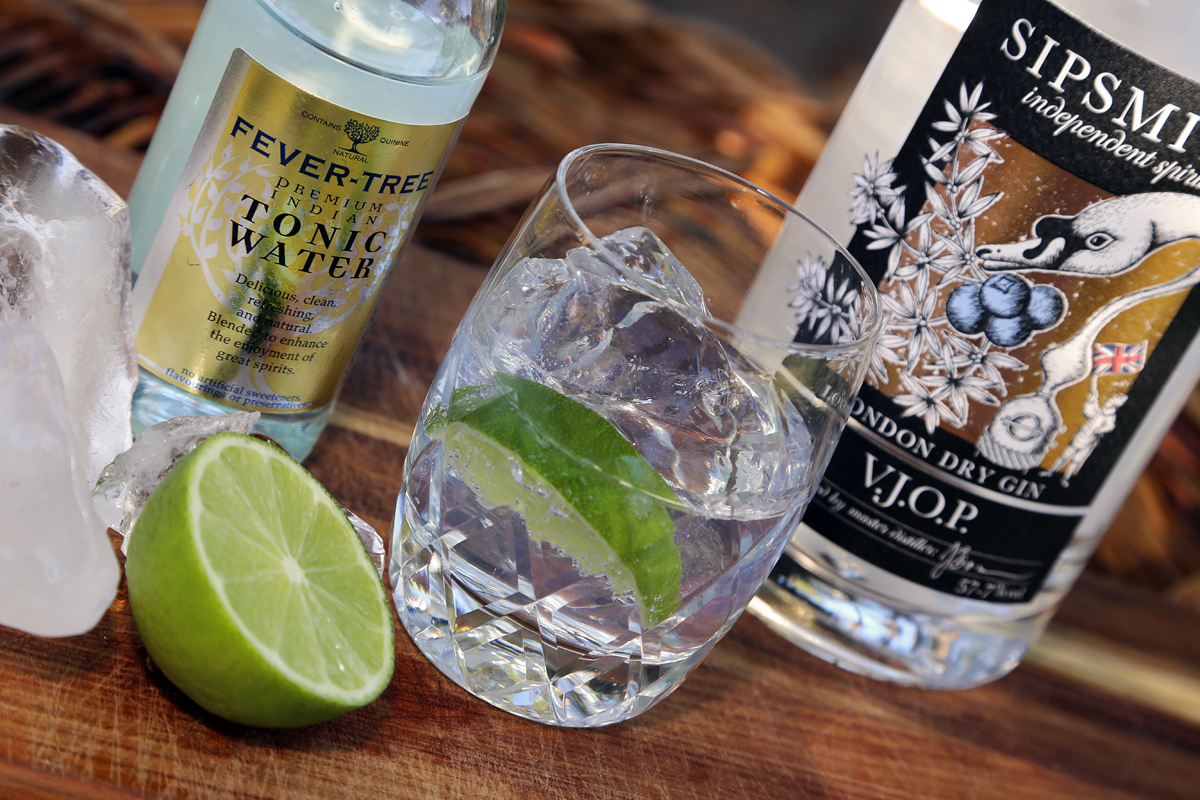
For this taste, I mixed 30ml Sipsmith VJOP, approx. 70-100ml Fever Tree Indian Tonic, a wedge of fresh lime (not squeezed), all stirred sparingly over a single large chunk of ice.

VJOP Gin and Tonic

I’m no bartender, but this was a mighty fine G&T. The VJOP/Fever Tree combo makes such a fresh, clean G&T, not dominated by any particular flavour. Not too sweet, nice and boozy with those lovely crisp juniper and coriander notes lingering long after you sip.

The Negroni

For this classic, I mixed 30ml Sipsmith VJOP, 30ml Campari and 30ml of sweet vermouth (your favourite will do the trick – I used Dolin Rouge). Stir over a single chunk of fresh ice, garnish with a twist of orange after rubbing down the rim of the glass.

VJOP Negroni

If I’m being honest, I’m often slightly let down by the Negronis I order when I’m out and about. Despite the three equal measure recipe, they aren’t always as balanced as I’d like, often being too heavy on the bitter notes, or too sweet for my liking.

This on the other hand really hit the spot. Still using the same three equal measure recipe, everything just seemed to balance in perfect harmony – drying peppery juniper, with just the right amount of bitterness and sweetness for my tastebuds. A strong concoction, but oh so tasty.

The whisky connection

Ok, so here goes – when the chaps at Sipsmith were in search of an inner London location to set up their distillery, they looked at a number of different places before finally settling on a quaint little blue and white garage in Hammersmith, north London.

1161-sipsmiths-alastair-wiper-40
Image the property of Sipsmith 

As it so turns out, the former occupant of this very location was the late great whisky writer, Mr Michael Jackson, who still holds the title of writing some of the best-selling whisky books of all time.

Some final musings

In short, this is a belter of a gin.

I wouldn’t consider myself a true gin connoisseur, but I’ve tasted more than enough to know what I do and don’t like and Sipsmith VJOP is certainly up there with the very best in my opinion. I like my drinks fairly strong and defined and for that reason, VJOP really suits my tastes to a tee. It might not be for everyone, but if you’re a fan of a juniper heavy gin, or a rather boozy and heady gin-based cocktail, then I’m fairly confident this will delight.

I’ve heard that the very first batch of VJOP was a Japanese market exclusive, bottled at a moderate 47.7%. It proved extremely popular and was quickly followed by 52% ABV batch #2 which flew off the shelves just as quick. Thankfully, the 57.7% ABV version now looks like it’s here to stay.

If you’re in Australia, I’ve heard that there might be one or two bottles available at the Oak Barrel in Sydney, otherwise keep your eyes peeled for a bottle on the shelf behind your favourite bar or boutique bottle shop.

A big thank you to Jye from Hippocampus Memorable Drinks for uniting me with a bottle of this very special gin. I’ll be savouring this one ‘till the last drop. Simply delicious.

Woodford Reserve tasting

Woodford Reserve tasting of epic proportions, Shirt Bar, Sydney

Ah Woodford Reserve. You bring back some vivid memories for me.

We enjoyed each other’s company a little too much on our last encounter though. It was great while it lasted – I had an absolute blast – though I spent much of the following day cursing your name and I wasn’t in a hurry to see you again.

That was unfair of me though. It wasn’t your fault, it was mine, so I’m really glad we had the chance to make up. And what better way to make up than with a bourbon tasting bonanza at Sydney’s Shirt Bar hosted by the incredibly knowledgeable, Mr Stuart Reeves.
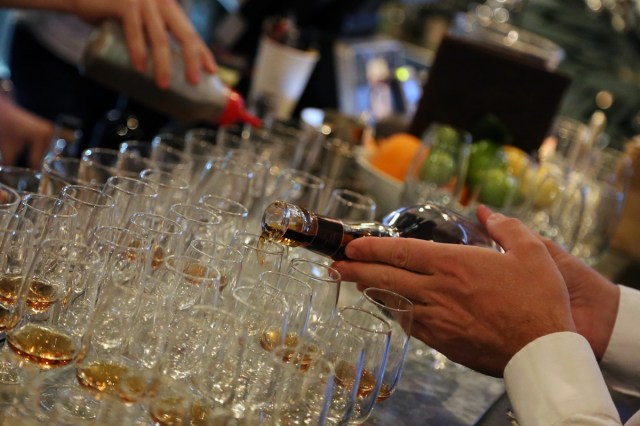
Woodford - Pouring

A bit of a forewarning here – If you’re not one for the details and a bit of a story, feel free to skip the wordy bits and start reading again when you get to the pretty pictures – this post’s a bit long. 

Woodford Reserve: The distillery

I’m a bit of a sucker for details. So it was a good thing that our host for the evening, Stuart, had a wealth of knowledge to impart. As told by Stuart, here’s a bit of info you’re probably not going to find on Woodford’s website:

  • For a brief period of time in the early 1870’s, Colonel EH Taylor (a name Rye whiskey fans might recognise) took over the distillery and patented a heat cycling process that’s still used in Woodford’s warehouses today (more on this in a sec)
  • Woodford’s current owners, Brown Forman, have actually had two bites of the cherry – purchasing the distillery for the first time in 1941 and again around 1993/ 1994. Reason for the first sale? The bourbon slump of the 1960’s.
  • During the above period, the distillery actually lay dormant from around from around 1970 until 1993 while under the ownership of someone who had intentions of turning it into a chemical plant of some description

As an aside, while absorbing these details like a fresh shamwow, we were all treated to a classic Woodford Reserve Old Fashioned – well executed by Shirt Bar’s crack team of bar tenders.
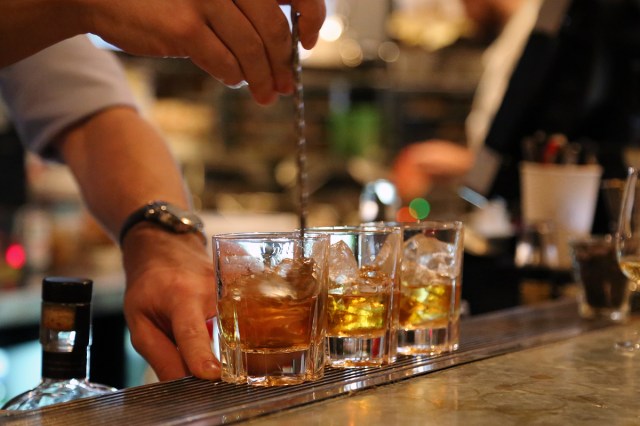
Woodford - OFs

Creating Woodford Reserve

At one point in time, I thought bourbon was just bourbon. But just like the Scotch whisky industry, the differences in production from distillery to distillery can be truly fascinating and they all factor into creating a unique product.

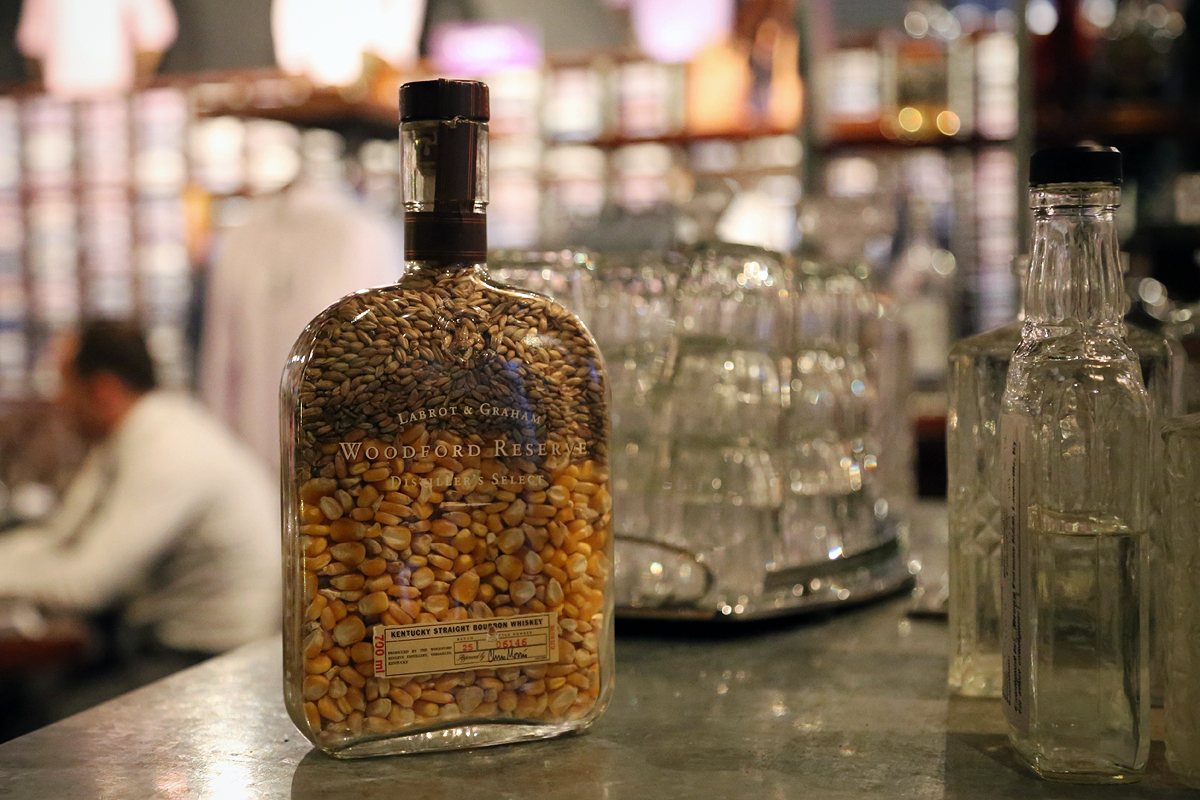
The first thing to note about Woodford Reserve is their standard grain bill, which is 72% corn, 18% rye and 10% barley. That’s a decent proportion of rye as far as bourbons go and Stuart brought along this neat visual representation.

Woodford - Grainbill

Here’s a few other interesting things that make Woodford, well, Woodford!

  • As opposed to using column stills (which are standard in the bourbon industry), Woodford use copper pot stills imported from Scotland (the same kind of still used in the production of Scotch whisky)
  • Woodford Reserve is the first and only triple distilled, copper-pot bourbon available in the US.
  • Woodford Reserve use only 6% sour in their mash, which means 94% of each distillation comes from fresh grain (industry standard for sour is around the 30% mark). Not sure what I mean by sour mash? Check this out.
  • Brown Forman own their own cooperage and make their own barrels – a whopping 2,900 of them a day! The number of those earmarked for Woodford Reserve? Around 100.
  • Those 100 barrels are special though – they’re the only barrels out there in the bourbon world where the heads of the barrel are toasted and charred as well as the barrel itself (I wonder if Ardbeg got this idea from them?)
  • Maturation warehouses are made of limestone rock and are heated in the winter with steam coils (enter EH Taylor). Why? To speed up maturation and keep it going at a constant rate, right throughout the year.
  • This takes its toll on cask volumes though. A staggering 50% of volume is lost to the Angels over seven to eight years.
  • One last one for the Scotch fans – some of Woodford’s barrels end up cradling the nectar of Balvenie and Glenfiddich.

What we tasted

If there’s a definition of a bourbon bonanza, then this is probably it. The line up for the evening included no less than six of Woodford Reserve’s finest, plus a few extras.

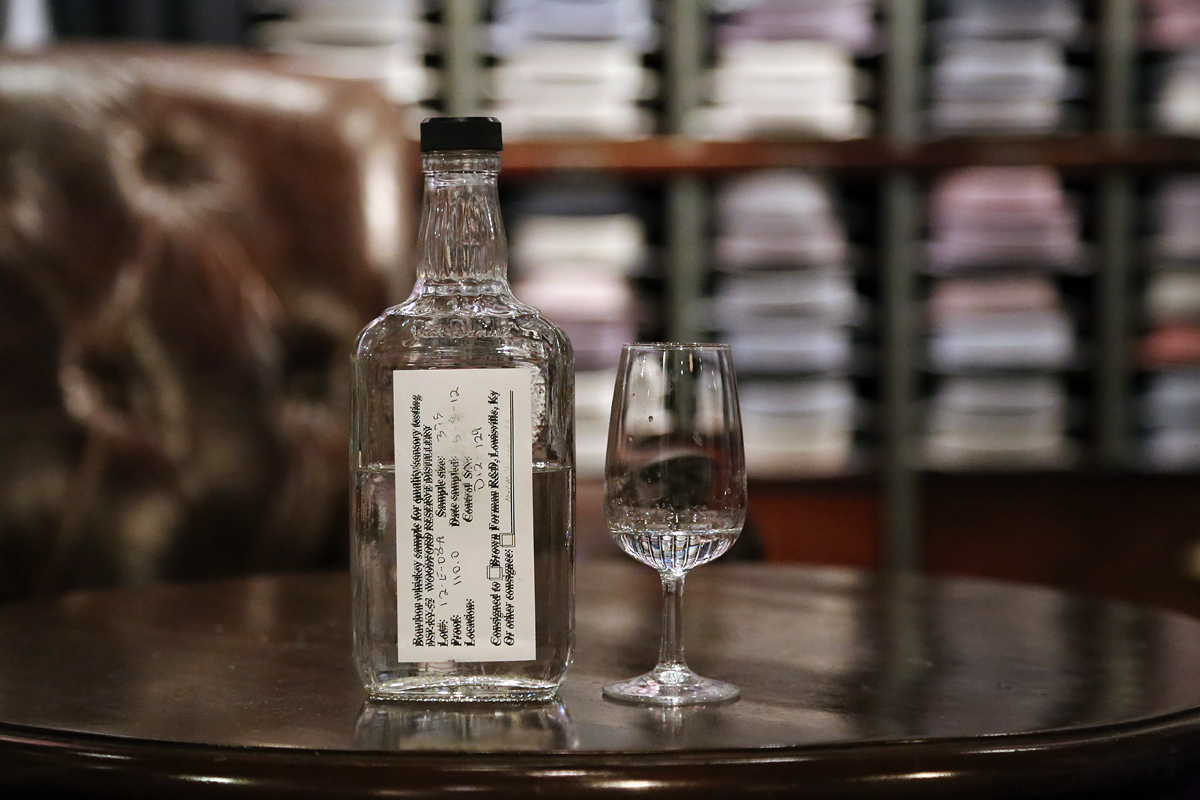
New make spirit

First up was Woodford Reserve new make spirit, also known as ‘White Dog’.

No, your eyes aren’t deceiving you, the label was misprinted and had you seeing double, before you even tasted it. Perhaps if you finish the bottle is become clearer?

Woodford - New make

On the nose, I got some sweet spirit notes, spice, some nutty herbal notes and a young grappa/ white rum kind of effect. There weren’t really any surprises on the palate, with the new make tasting clean, dry and spicy with some faint herbal flavours on the finish.

After being triple distilled, I expected their new make to have a really high alcohol content (ABV) and indeed it does when it comes off the third distillation at around 79% ABV (158 proof).

However, it was interesting to hear that they actually dilute the new make down to 55% ABV (or 110 proof) before casking it, as they believe it matures better and gets more flavour out of the cask, needing less dilution at the end!

Distiller’s Select

Next up was their flagship expression, Distiller’s Select. A seven to eight year old bourbon made with their standard grain bill, triple pot distilled and bottled at 43.2% ABV (I believe it’s bottled at 45.2% in the US?).
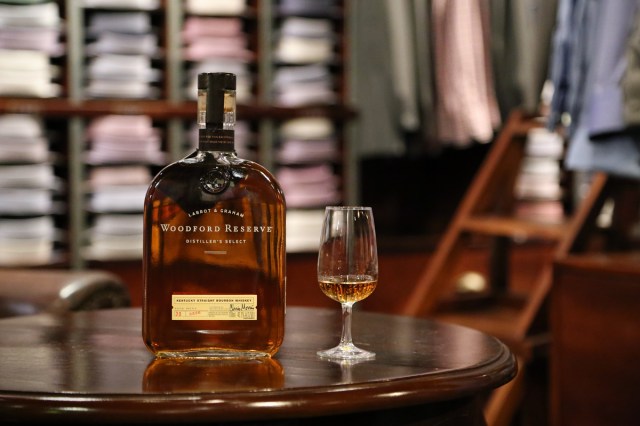
Woodford - Distillers Select

I got some lovely caramel notes on the nose, vanilla, orange, some nutty spice, woody furniture polish and grainy cereal swirled throughout. I found the Distiller’s Select to be a tad thin on the palate, big wave of spice and not quite as sweet as the nose suggested. Pleasant burnt caramel and woody notes, minus any bitterness faded to a medium length finish, mainly concentrated in the mouth.

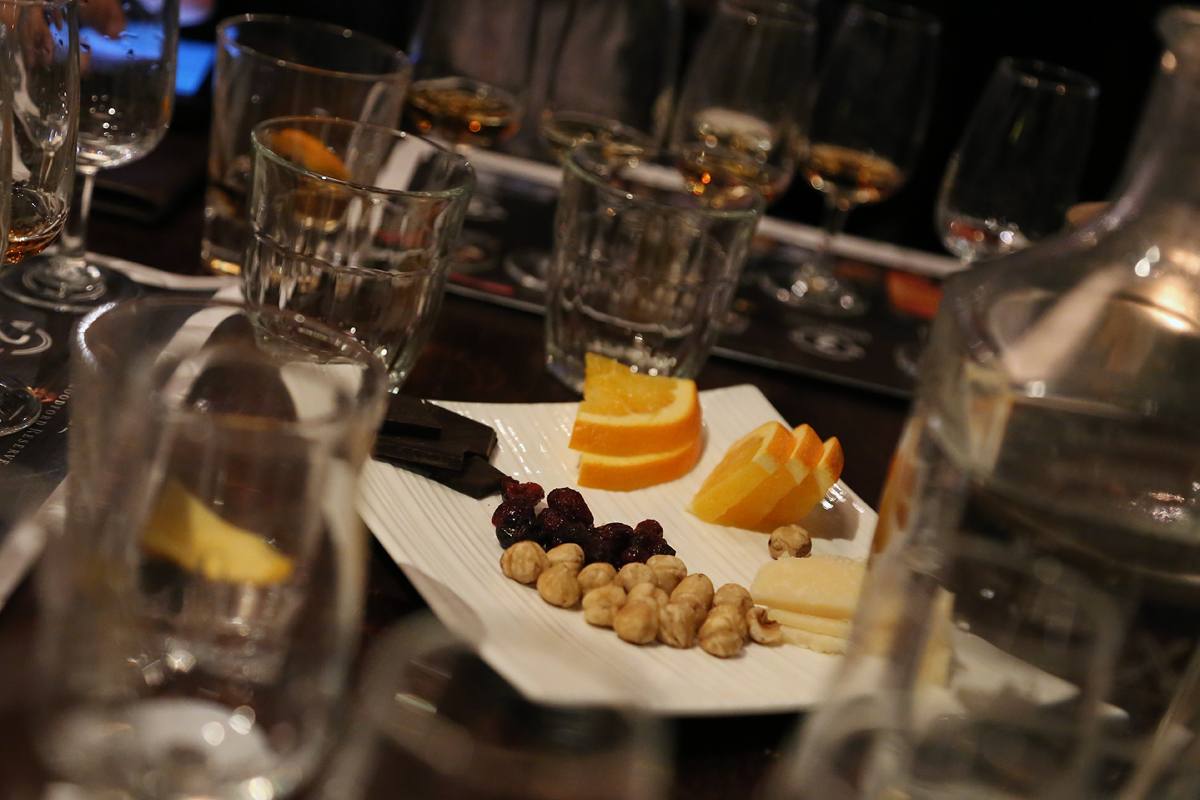
It was around this point that Stuart introduced some of the sensory tasting items he brought along, aimed at highlighting certain flavour characteristics. I picked up on the orange notes a fair bit in the Distiller’s Select, while the tart dried cranberries really emphasized the sweet caramel notes.

Woodford - Sensory

Before I move on from this one, ever wondered where the grain comes from? Probably not.. but I did and I can report the following: The corn comes from Kentucky, rye from Manitoba and barley from Wisconsin.

Maple Wood

Now we’re into the big league – the first of the Master’s Collection bottlings on taste. Created as one-offs, the Master’s Collection range is never intended to be repeated.

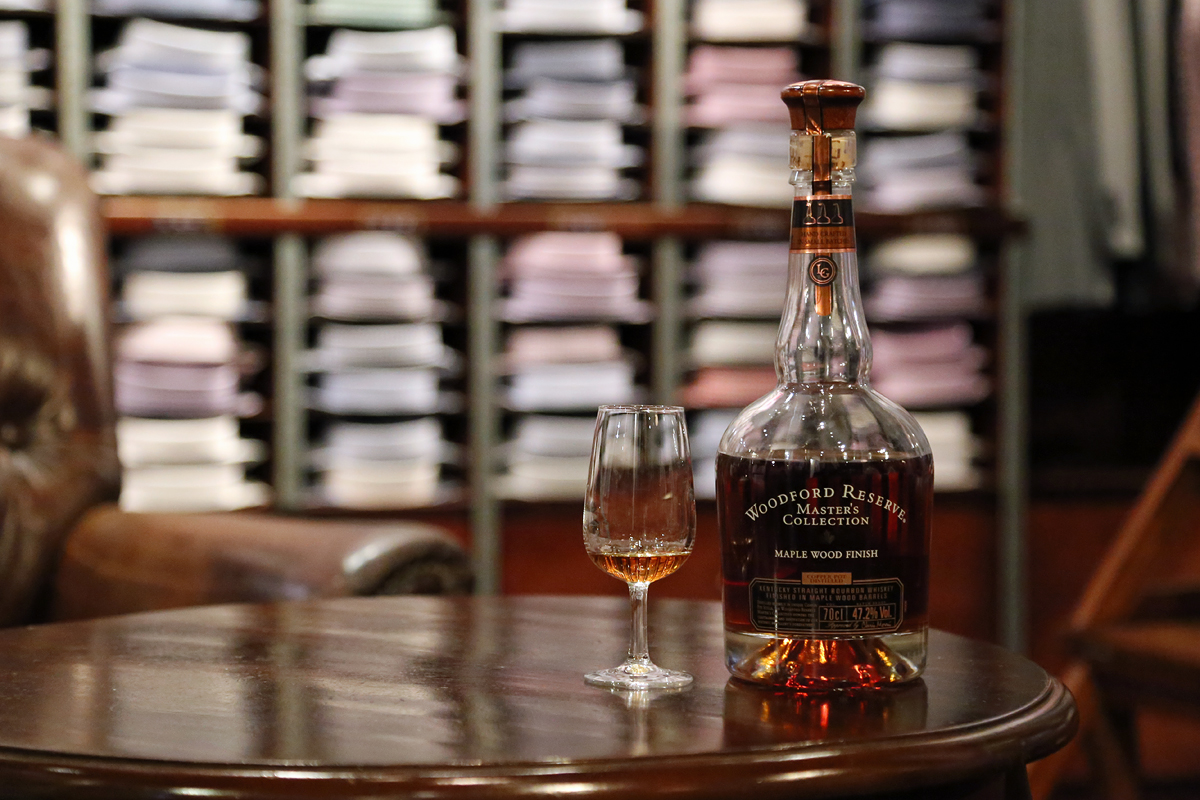
Released in 2010, the Maple Wood expression starts life as the standard Distiller’s Select, before being finished for around 18 months in a toasted sugar maple barrel.
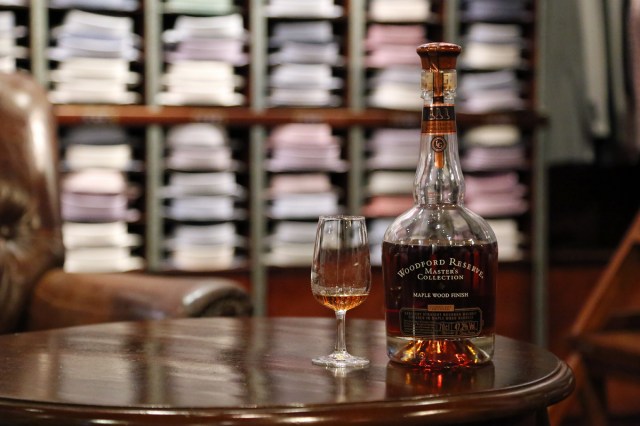
Woodford - Maple

On the nose I got some additional sweetness over the Distiller’s Select, but not in a caramel sense. More of a dark fruity syrupy sweetness, with a bit less spice. This translated to fuller palate, hints of sugared plums, fresh toffee, vanilla, cereal grains and restrained spice. At 47.2% ABV, the finish was noticeably longer.

Aged Cask Rye

Released in 2011, the Aged Cask Rye was sold in a twin pack with the New Cask Rye (coming up), so you could taste them side-by-side and taste the influence of the cask on the base spirit. A pretty neat concept in my opinion!

Woodford - Aged Rye

Made from a combination of both malted and un-malted rye, this represented another first for the distillery, being the first triple distilled 100% rye whiskey made in the world.

I got some interesting grassy notes on the nose, vanilla sweetness, crisp green apple, pineapple and hints of spice. Stuart likened this one to a young Calvados (apple brandy) and I think he was pretty spot-on with that analogy. On the palate, clean, mild citrus, dry, spice, some pepper and overall quite mild. I’ve never had a rye like this before!

New Cask Rye

Now for the comparison – exactly the same spirit as the previous version, but this time, matured in a fresh charred oak barrel and bottled at 46.2% ABV.
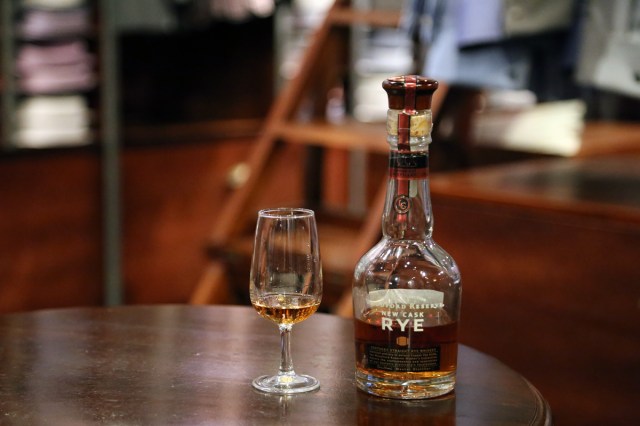
Woodford - New Cask Rye

Much sweeter on the nose, return of the Woodford caramel notes, vanilla, sweet balsamic, lots of vibrant spice, soy and hints of crisp apple. I thought this had a thicker mouth-feel, loads more caramel on the palate, spice, woody oaky flavours and a touch of cinnamon.

Interesting tidbit on these twins – although they both weigh in at 46.2% ABV, they actually entered the cask at a surprising low 43% ABV!

Four Wood

This was an interesting one. Released in 2012, as the name suggests, four different types of wood come into play.

As with the Maple Wood, this expression starts life as the standard Distiller’s Select. After seven to eight years though, a proportion is placed in a toasted sugar maple barrel for a year, another portion in ex-Oloroso sherry casks for six months and the remainder in Portuguese ruby port pipes for six months.

In the end, it’s all mingled together, bottled at 47.2% ABV and presented as the Woodford Reserve Four Wood.

Woodford - Four Wood

Sounds like it could have been the makings of total disaster, however it’s surprisingly balanced. Clear hints of port and sherry on the nose, some lovely raisin notes, vanilla, spice, caramel and still clearly Woodford. On the palate, I got some big spice upfront, followed by soaked raisin sweetness, vanilla and some malty cereal. Big sherried whisky fans would appreciate this one I reckon.

Classic Malt

To end the night, the one I had been eagerly awaiting! Released in 2013, the Classic Malt is essentially a single malt whisky, but made it the US by one of the most innovative bourbon distilleries. The mashbill is 100% malted barley, it’s triple distilled in copper pot stills and aged in used, ex-bourbon casks before being bottled at 45.2% ABV.
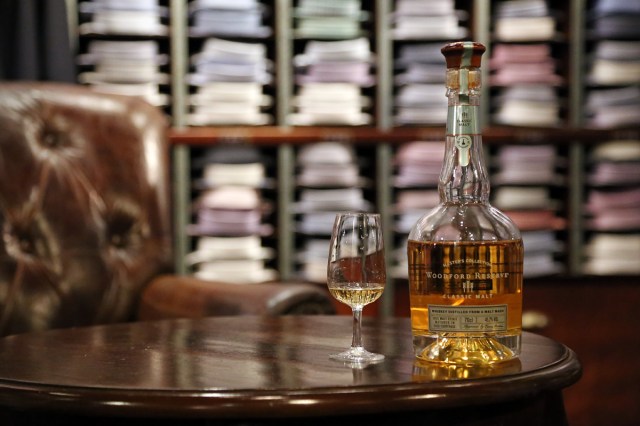
Woodford - Classic Malt

I got some serious grassy, grainy cereal notes on the nose. Lots of barley and freshly grated green apple. Reasonably thin on the palate, still quite grainy and grassy, but with an underlying sweetness and some vanilla. Not really to my taste, but quite delicate whisky, I mean, whiskey.

Andrew Derbidge, Cellarmaster of the SMWS was also in the room and likened this expression to an Auchentoshan single malt from the Lowlands of Scotland. Right on the money with that comparison in my opinion.

Some final thoughts

I’m not sure how impressive this lineup would look to someone in The States, but I have to say that we were mighty privileged to be tasting this number of Master’s Collection releases.
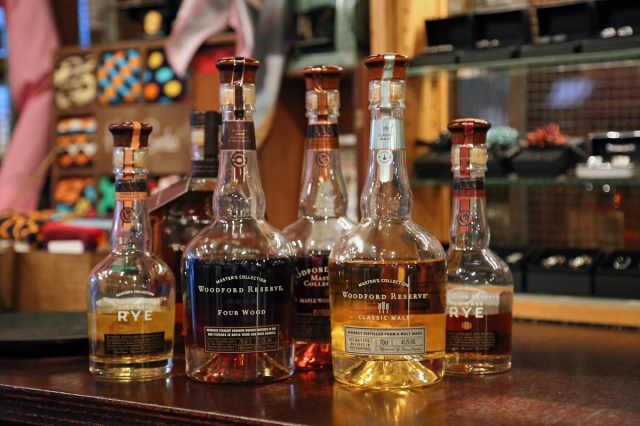
Woodford - Group

These releases are something of a rarity in Australia. You’d struggle to find these behind a bar if you wanted to taste them and if you managed to find a bottle for sale, you’d need to hand over $200+.

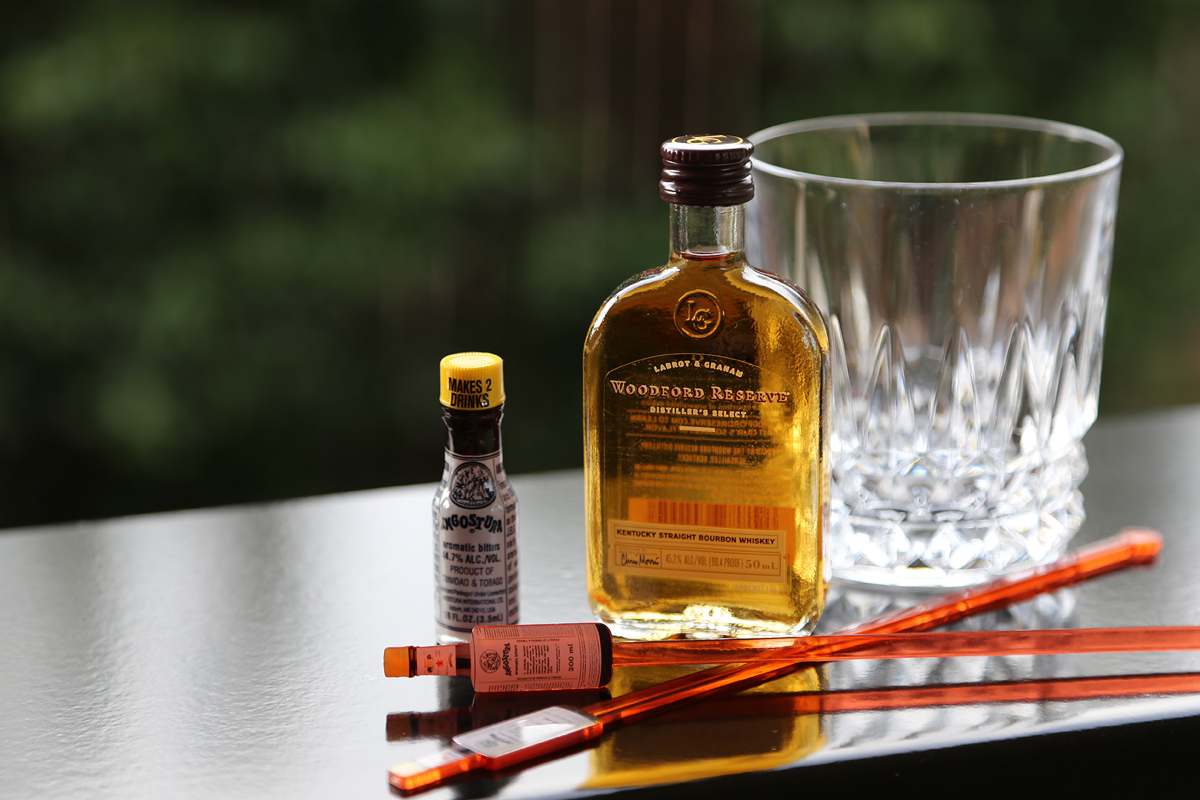
If that wasn’t quite enough, we each left with a goody bag comprising a Distiller’s Select miniature and the smallest bottle of bitters I’ve ever seen – perfect for mixing an Old Fashioned on the weekend.

Woodford - Goodies

Thanks to Stuart for presenting a highly informative tasting, sharing the story of Woodford Reserve and these fantastic bourbons (and whiskeys) with us. A big thanks to Shirt Bar as well for hosting another great evening – check out their website for info on their upcoming tastings.

Kilchoman tasting with Anthony Wills

Five expressions from Islay’s newest distillery

It doesn’t matter quite how busy my week gets, I always look forward to the whisky tastings held at the Oak Barrel in Sydney. The other week was no exception, so as soon as 6.30pm hit, into the tasting cave we ventured for a rather special Kilchoman masterclass.

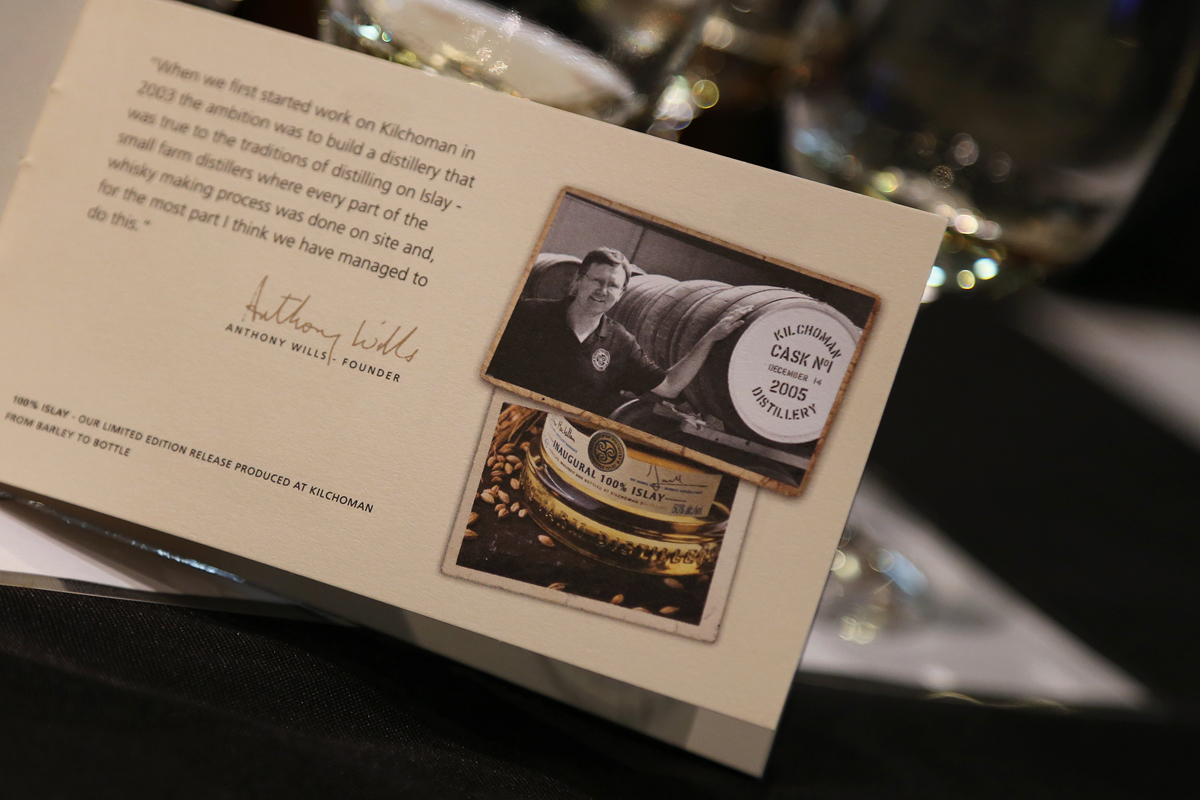
Kilchoman brochure

The Oak Barrel’s whisky expert, Dave, normally runs the tastings. But occasionally he takes a seat with the rest of us and invites someone along to present instead. It’s fair to say that he keeps pretty good company, because the other week we were privileged to have someone pretty special presenting for us – the founder and owner of Kilchoman Distillery, Mr Anthony Wills.

Kilchoman: The story 

You may know of Kilchoman as the first new distillery to be built on Islay in 125 years, but here are a few things you may not be aware of.

Kilchoman (pronounced kil-ho-man) is the brainchild of former independent whisky bottler, Mr Anthony Wills. After finding that it was becoming increasingly difficult for him to get his hands on quality single cask whiskies to bottle, Anthony came to the conclusion that there was only going to be one way for him to secure his own supply of whisky well into the future. How? To build his very own distillery of course!

I’m sure there are a lot of people out there who’ve had similar dreams, but the number who’ve actually turned that dream into reality? My guess is that you can probably count them on one hand.

Kilchoman - Brochure Anthony

With the financial and moral support of his family, in 2005 Anthony & Co. sunk a million pounds into refurbishing and rebuilding the distillery’s buildings and purchasing the required equipment.

With no money left for production (and no actual distilling experience), Anthony managed to convince John Maclellan to leave his secure, long-term job as Master Distiller at Bunnahabhain and come and work for him. He was joined by Dr Jim Swan, whom Anthony brought on-board to help define and craft a specific spirit for Kilchoman, one Anthony describes as ‘clean, floral, sweet and peaty’. And so by the end of 2005, the stills were run for the first time and Kilchoman’s very first American Oak cask was filled on 14 December 2005.

Kilchoman managed to make a trading profit after just five years in business and last year they produced over 130,000 litres of spirit – coming a very long way from their first year of production where they produced 50,000 litres of spirit and filled just 12 casks a week!

Edit: I’ve been reliably informed that John Maclellan didn’t actually join Kilchoman until 2010, well after the stills started running. Thanks to Andrew for clearing that up for me!

Kilchoman: The whiskies

After Anthony delivered this interesting and informative intro, it was time to get down to business and taste some whisky.

Kilchoman tasting glasses

Before we get into each one though, here are some Kilchoman fast facts:

  • The barley for all of their expression (except 100% Islay) comes from Port Ellen Maltings (who also supply to the likes of Ardbeg and Lagavulin).
  • The barley from Port Ellen Maltings is malted to standard Ardbeg specs, which is around 50 PPM
  • Kilchoman fill their barrels at 63.5% ABV
  • All of Kilchoman’s first fill bourbon barrels are sourced from Buffalo Trace in Kentucky
  • Their sherry casks are all from Miguel Martin in Jerez, Spain (the same supplier Glenfarclas use for all of their casks)
  • All Kilchoman bottlings (which are bottled on-site mind you) are Non-Chill Filtered and natural colour.

Summer 2010 Release 

You may have guessed it from the name, but this expression was released in the Summer of 2010 (Winter, if you were in Australia at the time.. it was probably the same temperature as a Scottish summer!) This release was matured in first fill bourbon barrels and after three years was bottled at a respectable 46% ABV.

Kilchoman - Summer 2010 

Quite fresh and light on the nose with some floral notes, light sweetness, hints of citrus and maybe some pineapple. Quite crisp and not overly peaty. This translated to a medium oily palate, with some sweet creamy floral vanilla and a big wave of fresh peat that hung around for a good while. A light salty tang on the finish. Delicate, but not my favourite. 

Interestingly, this expression was bottled in their original generic style bottle, before they had their own bespoke bottle mould produced. Ever wondered what a bottle mould costs? Kilchoman paid a cool 20,000 pounds! 

100% Islay 2nd edition 

The second expression personified what Kilchoman was all about when Anthony originally envisaged it – making a whisky that was 100% Islay. And so from the barley grown at Rockside Farm next door to the distillery, to the in-house malting using local peat, to the distilling, maturation and eventual bottling – it’s all done on Islay.

Kilchoman - 100 Islay

Does that actually give it a different profile though? You bet it did. A vatting of three and four year old whiskies, bottled at 50% ABV, 100% Islay had a noticeably different nose.

I got some malty grassy notes, vanilla, crème caramel and bananas nicely balanced out by the peat. This carried through to a lovely creamy and oily palate, vanilla and floral with peat sitting at the back of the palate. It finished with waves of warmth and hints of spice.

In case you’re wondering, the Rockside Farm barley is peated on-site using local peat for around 20 hours. This results in a level of around 10-20 PPM (parts per million). The barley is malted in two tonne batches and the whole malting process takes around 12-14 days. 

Machir Bay 2012 edition 

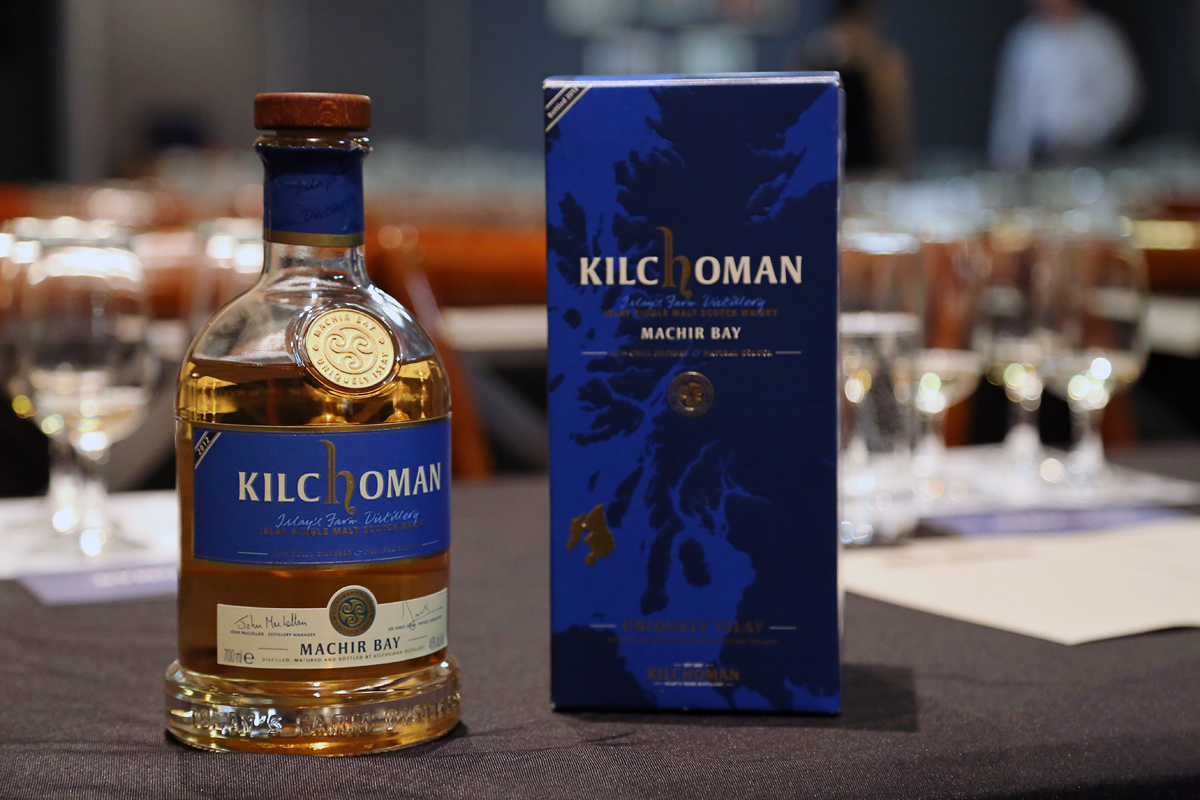
The first of Kilchoman’s core expressions, Machir Bay was released in 2012 as a vatting of three and four year old whiskies, with ‘a splash of five year old’ as Anthony put it. All came from first fill American Oak ex-bourbon barrels, however the vatting was finished in 20 year old ex-Oloroso casks for a couple of months prior to bottling.

Kilchoman - Machir Bay 

This has a noticeably heavier nose to the two before it – I got some hints of kiwi, a pleasant sourness, some fruitiness, light peat and hints of spice (presumably from the sherry finishing). Slightly thinner on the palate, but still creamy and sweet followed by a pronounced wave of vibrant peat.

Still a remarkably fresh and bright whisky, with none of the tarry medicinal notes often associated with bolder peated whiskies. 

Loch Gorm 1st release 

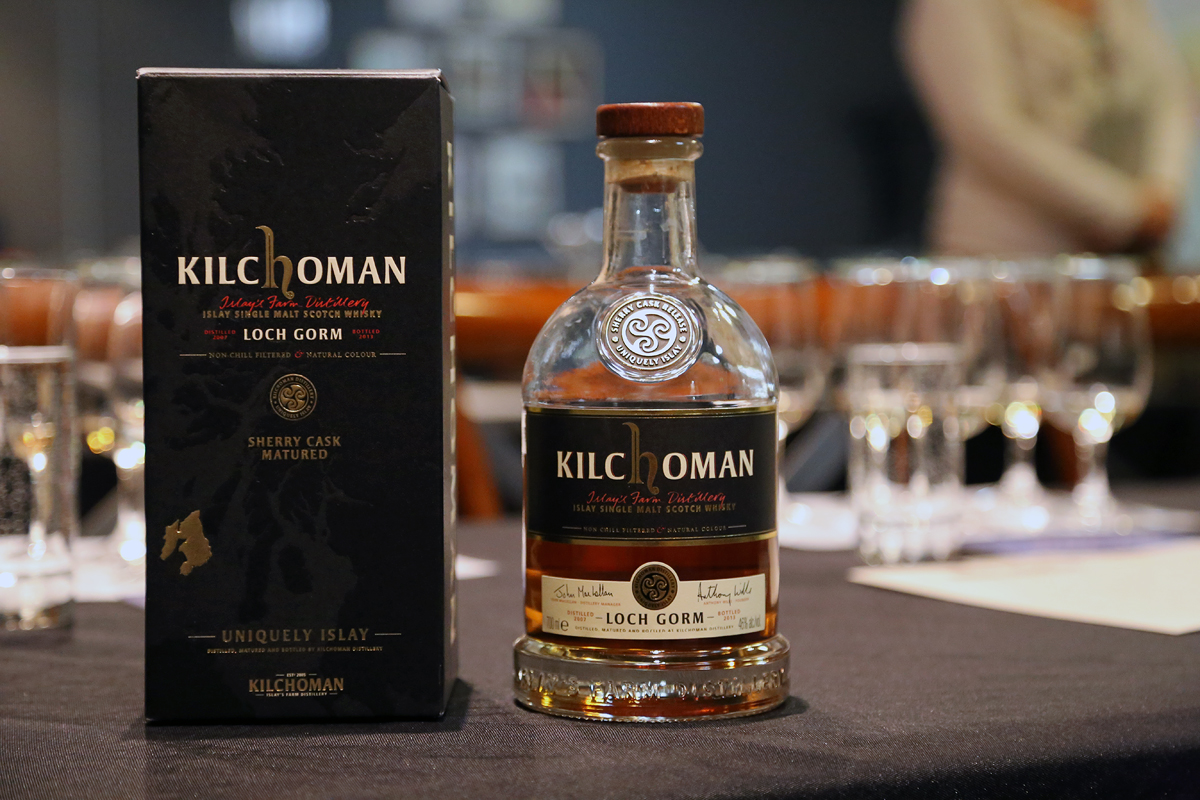
First released in 2013, Loch Gorm is a five year old Kilchoman solely matured in ex-European Oak sherry casks. In case that wasn’t enough, it’s then finished for a few months in fresh, first fill Oloroso casks, imparting the lovely dark liquid amber colour seen here.

Kilchoman - Loch Gorm

Compared to the three before it, Loch Gorm has a much weightier, heavy, meatier nose. You can see some more of my notes here but I want to mention something that I couldn’t articulate last time I tried Loch Gorm.

On our previous encounter, Loch Gorm confused me slightly. On initial nosing, it wasn’t the peat monster I was expecting, nor was it a fruity sherry bomb. The more I concentrated, the more these flavour profiles played hide and seek with one another.

Whilst I couldn’t put my finger on it at the time, I now feel as though this was simply a hallmark of a rather well-balanced nose. Indeed, Anthony was quite proud of Loch Gorm and mentioned that he felt much the same.

Cask strength small batch release

As far as I’m aware, this is the first time a single cask Kilchoman has been on taste in Australia. Another five year old, but this time matured in first fill bourbon barrels, then finished for around six weeks in Oloroso sherry casks. As for strength? A big and gutsy 58.2%…

Kilchoman - Small Batch

…but you wouldn’t have picked it from the nose! Certainly noticeable as a higher ABV whisky, but I wouldn’t have picked it being that high at all. Amazingly fresh, creamy nose with big waves of milk chocolate, mars bars and coffee beans, magically mixed with some grassy notes, pine trees, fresh peat and vanilla.

Much of this translated straight to the palate – lovely round, creamy flavours. More vanilla, milk chocolate, hints of salted caramel and a nice helping of peat looming in the background. Long, warming, creamy finish.

You should have seen the flurry of people filling in order forms for this one. It was seriously good!

Some final thoughts 

In many ways, the story of Kilchoman reminds me of some of Australia’s very own young distilleries. And like some of Australia’s young distilleries, Kilchoman’s output really is testament to the fact that young whisky can be bloody good whisky.

Anthony took the time to explain that he and Jim Swan set out to produce a spirit that would mature reasonably quickly and taste great when bottled young. With that in mind, I think he and his team have really hit the mark with their latest round of releases.

As for the evening – It’s always great to hear from brand ambassadors, especially those who are knowledgable and enthusiastic. But there’s something different about listening to someone who’s been there from day one, someone who had an idea and saw it become reality and someone who knows the ins and outs of every aspect of their distillery and is happy to share every little detail.

Anthony Wills

On that note, I’d like to say a sincere thanks to Mr Anthony Wills for flying half way across the world to share the story of Kilchoman with us. A special thank you is also in order for Dave and The Oak Barrel for hosting another fantastic tasting and to Island2Island for bringing Kilchoman and Anthony to our shores.

Johnnie Walker – The Gold Route

No age statement, Travel Retail exclusive, released 2013, 40% ABV, American Oak

Late last year my father was given this handsomely presented Johnnie Walker for his birthday (along with two other JW’s – people, get a bit more creative with your whisky selections!)

JW Gold Route - Box

I didn’t know a single thing about it, so I hit the ole’ interwebz to do a bit of research and reading to get a better understanding of what I was about to taste.

Launched around March 2013, The Gold Route is the second release in the Johnnie Walker Explorers’ Club Collection – Trade Route Series (what a mouthful). It followed on from 2012’s The Spice Road and preceded the final release in the series, The Royal Silk Route which came out in October last year.

JW Gold Route - Lid

A series of three duty free/travel retail exclusives, the Trade Route Series pays homage to the travelling heritage of the John Walker & Sons agents who journeyed the world, bringing the Johnnie Walker brand to over 120 countries by the 1920s.

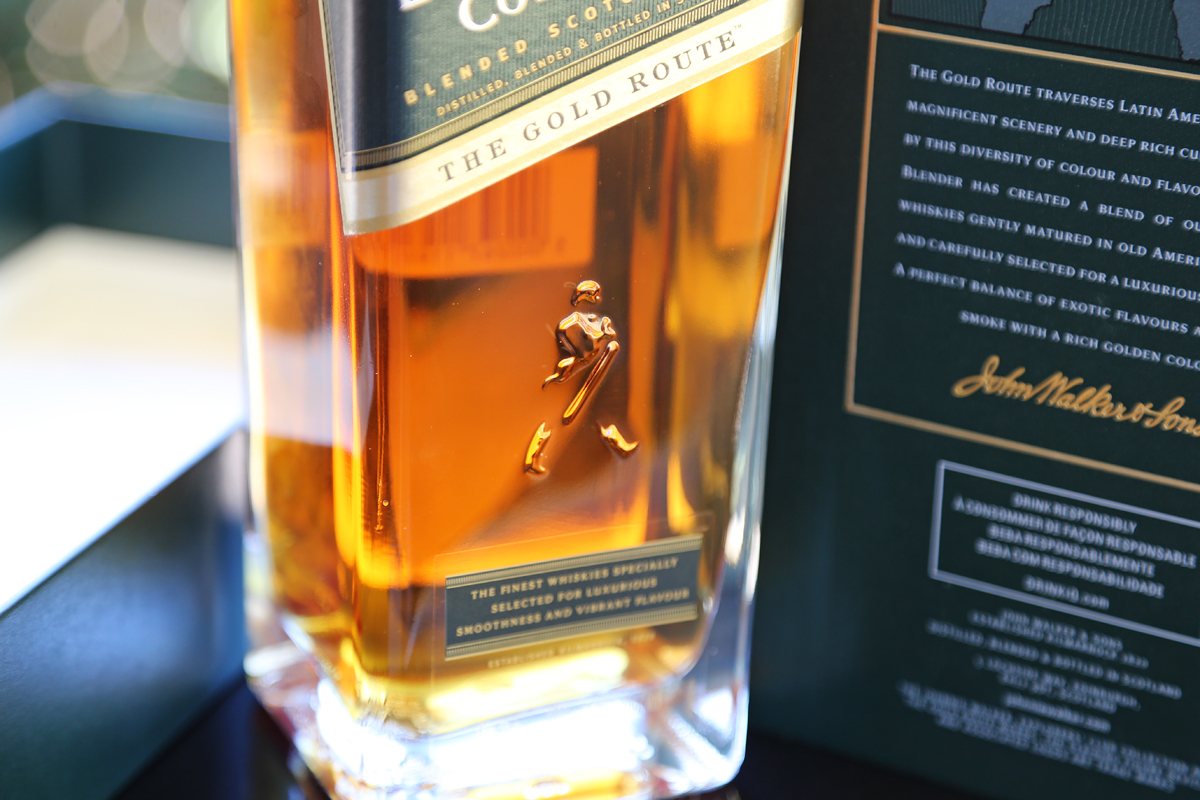
It’s a well-presented whisky, that’s for sure, and it’s not hard to see why someone travelling through an airport would be attracted to it.

JW Gold Route - Striding Man

This particular expression pays tribute to The Gold Route (or The Route of Gold), which runs through Central America, the Andean mountains and along the coast of the Pacific Ocean. The gold to come out of this region was used in some of Europe’s most well known churches and palaces and also provided some of the wealth on which cities like Rio and Lisbon were built.

JW Gold Route - Map

Not surprisingly, Johnnie Walker’s owners, Diageo, were able to put together a pretty impressive marketing campaign for this release (and indeed the whole Explorers’ Club Collection).

JW Gold Route - Stock photo

There was a full photographic series featuring evocative images (such as the one above), elaborate store displays in airports around the world and a youtube video for each expression in the series

Although it was likely dreamt up by a clever marketing department, the whole celebration of travel and trade theme ties in rather nicely with the fact that it was only available in travel retail. I sometimes wonder how many purchasers would actually make that connection for themselves, but in any case, I noticed it and thought it was a nice touch.

What Master Blender, Jim Beveridge, says

“On the nose, there is an immediate wave of an exotic mix of bananas, mango and pitaya, complemented by a hint of vanilla sweetness. On first sip, the palate embarks on a journey that is as distinct and magnificent as the vistas of Latin America: tantalising flavours, a perfect blend of fruitiness with hints of pineapples, guava, passion fruit and raisins, all balanced perfectly by deep charred peaty notes, in keeping with the signature bold and smoky JOHNNIE WALKER flavour”

Here’s what I think

Nose

Sweet peat, a few meaty sherry notes, quite sooty and malty with hints of vanilla and some light coastal notes in there. A few months later, much softer and sweeter, really faint underlying smoke (almost completely gone), more of a zesty lemon tang kind of note, a touch of honey and some papaya hidden in there somewhere.

Despite the comments above, I would still call this a light-weight nose. Not overly heavy or deep (if that makes any sense).

Palate

First impression is that it’s thin and has a really soft entry. A decent amount of medicinal peat, tart orange marmalade, very little heat and very little spice. A few months later, quite a bit sweeter than I remember, hints of raisin, very little-to-no peat on the palate and a bit grainy.

Initially it was much peatier and smokier than any JW expression I’ve tried before, but that seems to have faded dramatically.

Finish

Initially quite mild, with very mild mouth warmth and some residual peat. Little-to-no spice or oak. After a few months, still a very mild finish in terms of length and warmth, but much more drying spice and some earthy/woody notes. Pencil shavings? (no, I’ve never eaten pencil shavings, but I imagine this is what they’d taste like!)

Comments

I must admit, I was somewhat surprised with this release (in a pleasant kind of way). I’ve never been overly thrilled with the Johnnie Walker’s I’ve tried to date. Not because of the whole ‘blend stigma’, but because I’ve always just found them a bit flat for my liking and lacking in any kind of complexity.

This on the other hand does actually have some degree of complexity to it. It’s got a rather interesting nose and the palate leaves you curious as to its make-up.

I do have to say though, the nose and palate on this changed dramatically between the time the bottle was first opened and month or two later. I’m not sure which nose I prefer, but the bottle has lost almost all of the smoky-peat notes on both the nose and palate and is generally a bit sweeter.

Overall, it’s still too thin, young and grainy for my liking, but it’s a pretty solid offering. I know big one litre bottles are a travel retail thing, but for someone who enjoys their whisky neat, I would rather have seen this in a 700ml bottle, bottled at 43% ABV, instead of one litre at 40% ABV. I think that would have gone some way to helping the thin mouth-feel and short finish.

The Gold Route retails for around AU $90 in Sydney, which isn’t too bad and I’m sure it’ll sell quite well.