Nikka whisky tasting

A round of Nikka nightcaps at Shirt Bar in Sydney

A stroll from Sydney’s Wynyard Station in a small laneway separating Kent Street and Sussex Street, you’ll find a cosy coffee by day/drinks by night establishment called Shirt Bar. Oh I left one thing out, they also sell shirts – lots of them!

Shirt bar

According to their site, they’re all about three of the things they love ‘tailored shirts, freshly roasted coffee and great whisky’. Walk through the doors and it’s not hard to see this represented in the eclectic styling of the warm and friendly fit-out.

Shirt Bar - Menu

Anyone who knows me knows how much I enjoy a nicely tailored shirt and a good coffee. But on a miserable, rainy Wednesday evening, it was Shirt Bar’s third love that saw me perched at a table up the back with some like-minded company. See, they don’t just enjoy and serve great whisky, but they’ve gone one step further and have set up their own appreciation group aptly called Scotch Club.

Pouring

I always keep an eye out for drinks and whisky tastings in Sydney and I’d read a bit about Scotch Club. I’m on their mailing list and I’ve read some great reviews of their events by fellow whisky fans Martin and The Baron – but their events always happened to fall on a weeknight when priorities clashed, so I’d never actually been along to one.

This was about to change though. My first Scotch Club was all about some of the whiskies that come out of Japan’s Nikka distilleries, Miyagikyo and Yoichi. To take us through four of their whiskies, our host for the evening was their Australian brand ambassador, Taka.
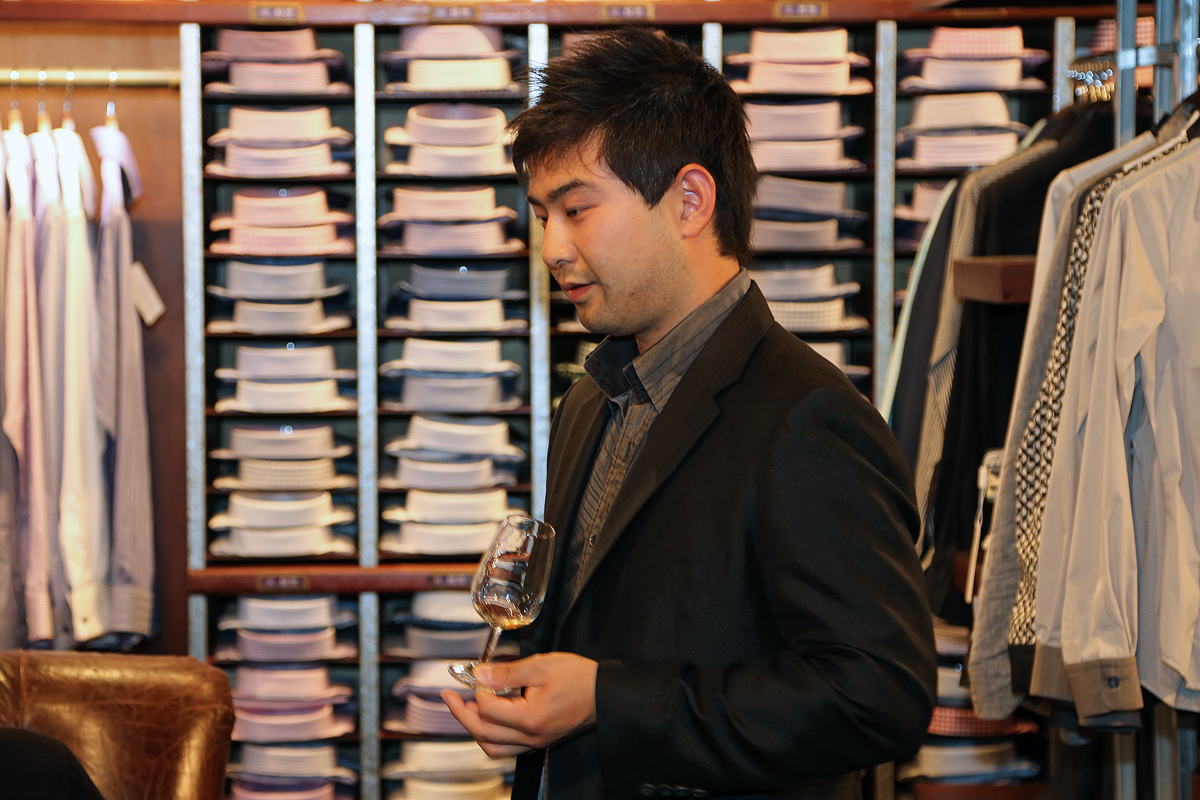
Taka

I must admit I haven’t had a whole lot of exposure to Japanese whisky, so I was really looking forward to this tasting. Here’s what we got to taste.

Miyagikyo 12 year old

Miyagiko 12

First up was a single malt from the Miyagikyo distillery, which you’ll find in northern Honshu, near Sendai. Built in 1969, the Miyagikyo distillery produces a lighter style of whisky thanks to its steam-fired bell-shaped stills, which require a longer and gentler distilling process. Interestingly (for a whisky nerd like me), the stills also have an ascending lyne arm, ensuring only the lightest spirit is collected.

This was indeed noticeable when nosing and tasting. On the nose, I got some citrus, apple cider notes, pear and a touch of sweetness and spice. I also got a note that I couldn’t quite put my finger on, but I jotted down ‘oddly meaty’ – whatever that means!

Fairly thin and light on the palate (surprising for a 45% ABV), reminded me very much of a Lowland style Scotch whisky. Soft sweetness, slight sourness, pears and quite a dry white wine-like finish.

Yoichi 15 year old

Yoichi 15

The next single malt came from the second distillery in Nikka’s portfolio, Yoichi.

In contrast to Miyagikyo, at Yoichi, they have a much faster and more intense distilling process, using direct coal-fired straight column stills fitted with descending lyne arms. Their water source is an interesting one too – using naturally peated water collected from an underground aquifer that lies beneath the distillery itself. All of these factors contribute toward producing a much heavier style of whisky.

On the nose I got a hint of sweet smoke, salted caramel notes and something a bit raisin-y. Much heavier on the palate than the Miyagikyo (they’re both bottled at 45% ABV) with some salty/saline notes, seaweed, light smoke and a bit of spice on the finish.

Taketsuru 12 year old

Taketsuru

The Taketsuru Pure Malt 12 year old is a blend of both Yoichi and Miyagikyo single malt whiskies (so there’s no grain in this one – similar idea to the Johnnie Walker Green Label).

Bottled at 40% ABV, this was the lightest of them all. I got some green apples and pears on the nose, vanilla notes and touch of spice. Reminded me a little bit of The Glenlivet 12 year old. Very smooth on the first sip, light sweetness, some gentle sour apple notes, maybe a touch of nuttiness, then bang – nothing. This has got to be the shortest finishing whisky I’ve ever come across. I think apple juice probably has a longer finish then this.

That’s not to say it’s a bad whisky (because its not), but I personally didn’t find it overly satisfying. I can see this being a great introductory whisky for a first-timer.

Nikka from the barrel
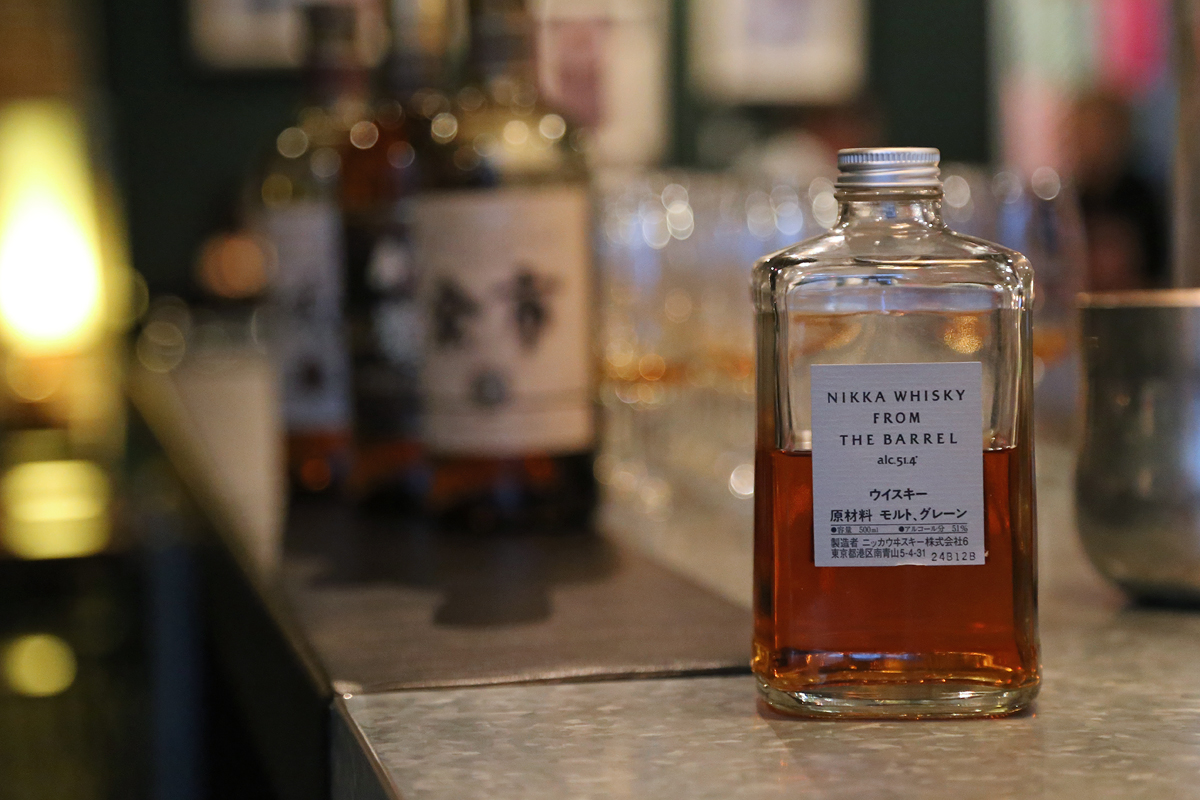
Nikka

The last whisky of the evening was also a blend of single malts from Yoichi and Miyagikyo, but this time there’s some aged grain spirit in there too – specifically, a grain spirit produced at Miyagikyo using imported corn from the US! The components are then married together and left to sit for a few months before being bottled.

Lovely and rich on the nose, sweet fruits, creamy, hints of spice and some faint bourbon notes. Big and juicy on the palate (it’s bottled at 51.4% ABV), caramel sweetness and some vanilla finish with pleasing spice notes.

I had only ever heard good things about Nikka from the barrel and it’s not hard to see why – it’s a mighty fine blend indeed.

Some final thoughts

Group

I should also mention that the tasting was accompanied by some quality food – individual servings of sushi, plus generously-sized charcuterie and cheese share plates.

As for the venue, Shirt Bar really is quite a cosy spot. The eclectic styling, interesting furnishings and odd bits of bar and tailoring paraphernalia make it an enjoyable spot to just sit back, relax and enjoy a few drinks, and that’s what the crowd seemed to do. Whatever your reason for being there, it looked like everyone was enjoying themselves.

The pours were a bit on the light side and I probably didn’t get to taste enough of each whisky to develop a proper opinion. But one thing I did get out of the evening was a real interest in exploring the world of Japanese whisky a whole lot more.

Whilst it’s a much younger industry (compared to the Scotch whisky industry), it’s still rich with history and great stories that make some of these whiskies truly fascinating.

Whisky tasting with Ian MacMillan

Sampling some of Burn Stewart’s finest single malts at The Wild Rover, Sydney

Earlier this week I was fortunate enough to be invited to a rather special whisky masterclass hosted by a true stalwart of the whisky industry, Mr Ian MacMillan.

A long way from home, Ian was on his first-ever Australian visit to attend the Top Shelf boutique drinks festival down in Melbourne. But before making the 17,000-odd kilometer journey back to Scotland, he generously found some time in his schedule to host this great masterclass at The Wild Rover in Sydney’s Surry Hills (keep an eye out for a post on this very cool bar shortly!)

Ian MacMillan

I refer to Ian as a true stalwart as he entered the whisky industry at the age of 18, starting his career at the Glengoyne distillery back in 1973. Over the following 40 years, Ian worked his way through numerous distilleries, from the ground up. He proudly tells us that he’s one of few in the industry today who can honestly say that they’ve ‘worked every single job in a distillery’.

It’s this kind of dedication that’s lead him to where he is today, as Head of Distilleries and Master Blender for Burn Stewart Distillers. Even if you haven’t heard of Burn Stewart, you’ve probably heard of their single malts – Deasnton, Bunnahabhain and Tobermory.

On with the drams then!

I would have been pretty happy to just listen to Ian’s fascinating stories all afternoon, but we were at The Wild Rover to taste some whisky – and taste whisky we did.

Tasting glasses

Before I launch into these though, it’d be remiss of me to not mention something about Ian’s whisky making philosophy. You see, he took great pride in explaining that when it comes to whisky making, he considers himself a ‘pure traditionalist’.

Among other things, he made a particular point of  recognising the role that people play in making the whiskies in the Burn Stewart portfolio. ‘The people working at these distilleries have such pride and are so proud of what they make … tell me of any computer panel that has that kind of passion for making liquid’.

It’s also worth pointing out that all four of the single malts we tried were non-chill filtered, natural colour and bottled at a generously enjoyable 46.3% ABV.

Ian talking

Ian’s reasoning behind non-chill filtering was a pretty good one too.. ‘we’d been making whisky for 800-odd years before chill filtration was invented and there was bugger-all wrong with it back then’ – so why do it now? Classic.

I found his whole approach pretty admirable and after hearing what Ian had to say, I couldn’t help but feel like it added a little something special to the four whiskies we were about to taste.

Deanston 12 year old

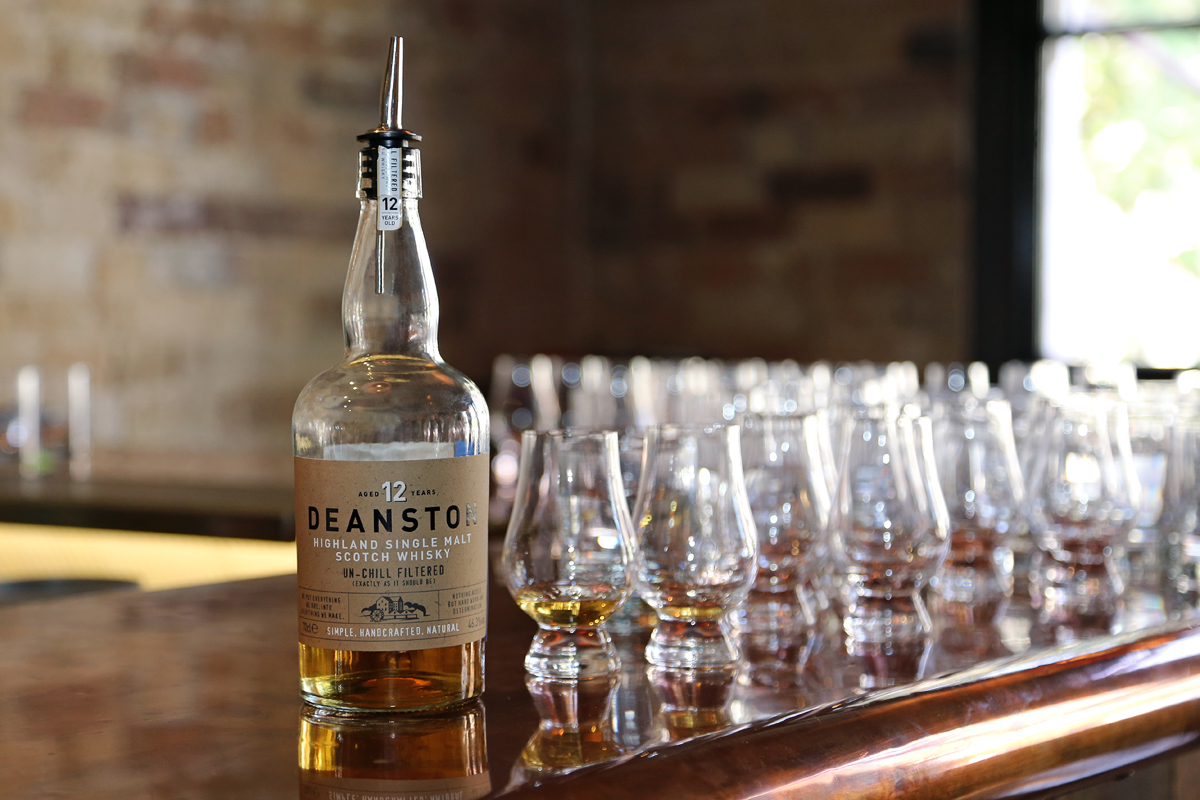
First cab off the rank was a whisky that I’d heard of, but never tasted – Deanston 12 year old. From Perthshire in the Central Highlands region, Deanston was opened in 1966 in an old cotton mill.

Deanston 12

Ian reckon’s it’s the most honey-influenced malt you’ll find. I always thought The Balvenie would hold that crown, but after tasting it, he could indeed be right!

Matured solely in ex-bourbon American Oak casks, I got some big honey notes on the nose, with hints of a citrus-tang, sweetness, orange zest and vanilla. This translated rather nicely to the creamy, oily palate with fresh zesty citrus notes and honeycomb sweetness finishing with some light spice.

Bunnahabhain 12 year old

For those of you who haven’t encountered Bunnahabhain before, it’s produced on the isle of Islay, but unlike some of its heavily peated brethren, Bunnahabhain’s core range is actually un-peated (well, that’s a little lie, it’s peated to around 2 – 3 parts per million – but that’s almost nothing).

Bunnahabhain 12

Around 40% of the content in the 12 year old is matured in first-fill ex-Oloroso sherry casks, so you get some wonderful nutty raisin notes mixed in with some light zesty fruit, sweet cured meat (well, that’s what I was reminded of anyway!) and the faintest whiff of smoke.

The intriguing nose is followed by a lovely viscous palate that nicely balances sweet and salty elements, fruit and really mild peat, finishing with a briny/salty tang. I’ve got a bit of a soft spot for this one.

Tobermory 15 year old 

You’ll find Tobermory off the west-coast of Scotland on the Isle of Mull where they’ve officially been distilling since 1798. I say ‘official’, as records show that they actually started some 300 years earlier, back in the 15th century! 

Tobermory 15

Quite a unique, heavy nose on this. I got hints of roasted coffee, dark chocolate, dark fruits and a faint salty/tangy note. Looking back over my notes, I think I wrote the word ‘rich’ about three times without realizing it.

As with the other two, another lovely oily mouth-feel on the Tobermory. Flavour wise, I couldn’t help but be reminded of fruit and nut chocolate, fruity sherry (minus the sweetness) and a slight tang, all giving way to a long warming finish. 

Ledaig 10 year old 

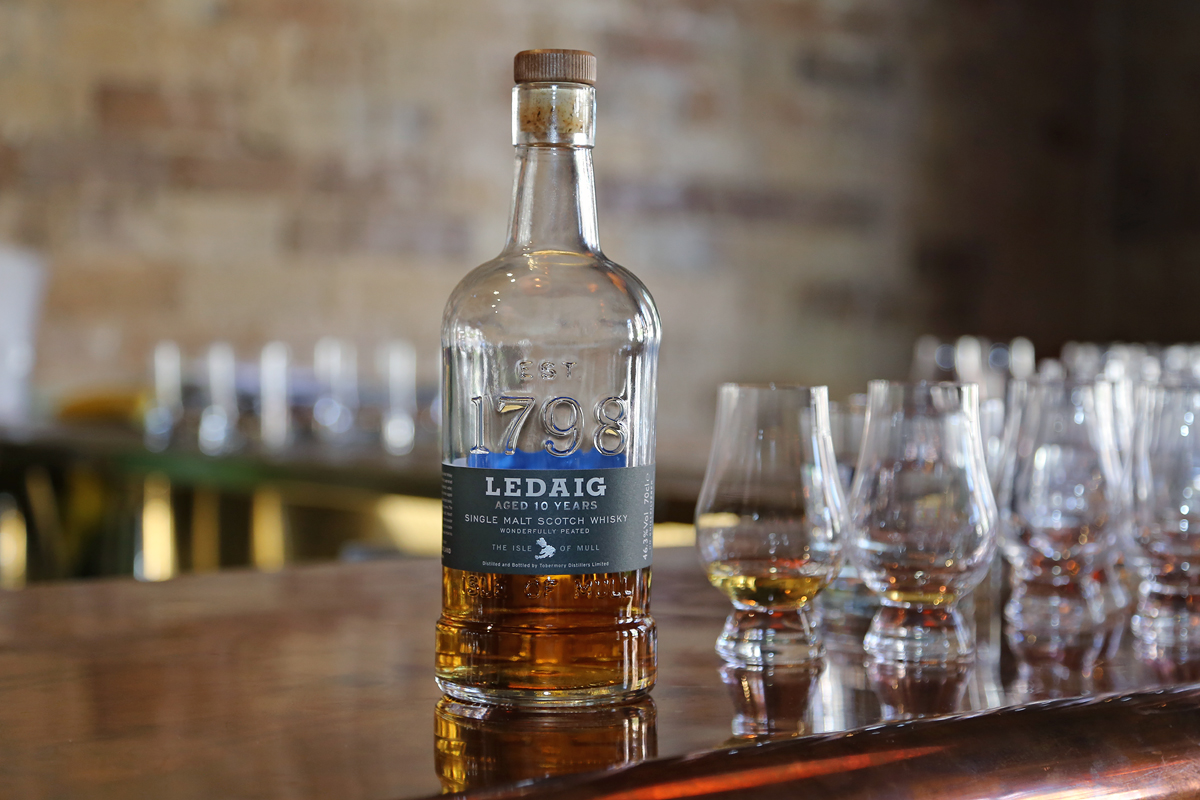
Ah Ledaig. Looks simple to pronounce – Lé day-g – but if you, like me, thought that’s how it’s pronounced, then you’d be wrong. Ian tells us it’s pronounced something like ‘Lech-igg’ or ‘Led-chigg’. Got to love Gaelic. 

Ledaig 10

Produced at Tobermory, Ian informs us that with Ledaig, he set out to produce a whisky that was similar in characteristic to what would have originally been produced at Tobermory.

On the nose, the Ledaig 10 year old has light, warming wood-smoke honey notes. This translates nicely to an oily palate and a warming finish, with hints of citrus that turn rather drying after a short while.

Some final thoughts

The masterclass drew a crowd predominantly made up of industry and bar staff from all over Sydney, but there also happened to be two of Sydney’s finest drinks bloggers in the room – Corinne from Gourmantic and Matt from Distant Thunder Whisky Club – two fellow whisky fans whose sites are well worth the read. It was a real pleasure meeting you both!

I don’t know about everyone else in the room, but I already had a bit of a soft spot for Bunnahabhain and Tobermory. After hearing more about them, I feel as though these are a couple of quality, underrated whiskies that drink a fair bit higher than they’re often scored. I’d definitely keep an eye out for these behind your favourite bar if you’re looking to try something new.

A sincere thanks to Ian MacMillan for his time and to the folks at Island2Island Beverage Company for brining him out to Australia. I genuinely hope we get to see more of him, and his whiskies, in the near future.

The best of the rest

What better way to spend a weeknight than with some fine whisky. That’s exactly how a recent Wednesday evening panned out for me, with the Oak Barrel in Sydney holding their final whisky masterclass for the year – The best of the rest.

The Oak Barrel

Throughout the year, Dave (the Oak Barrel’s grand whisky master – probably not his title, but we’ll pretend it is) puts on a series of different masterclasses and 2013 saw some stunners. Among others, there was the Glendronach single cask masterclass at the beginning of the year. The smoke stack and smoke signal classes, exploring all things peaty (not just Islay peat) and the sherry and sherried whisky class – pairing sherried whiskies with their sherry counterparts (think fino, oloroso, pedro ximenez etc.)

As the year draws to an end though, there were some great whiskies discovered in 2013 that hadn’t had their chance to shine, so this was their night. Here are some short notes on the six tasted.

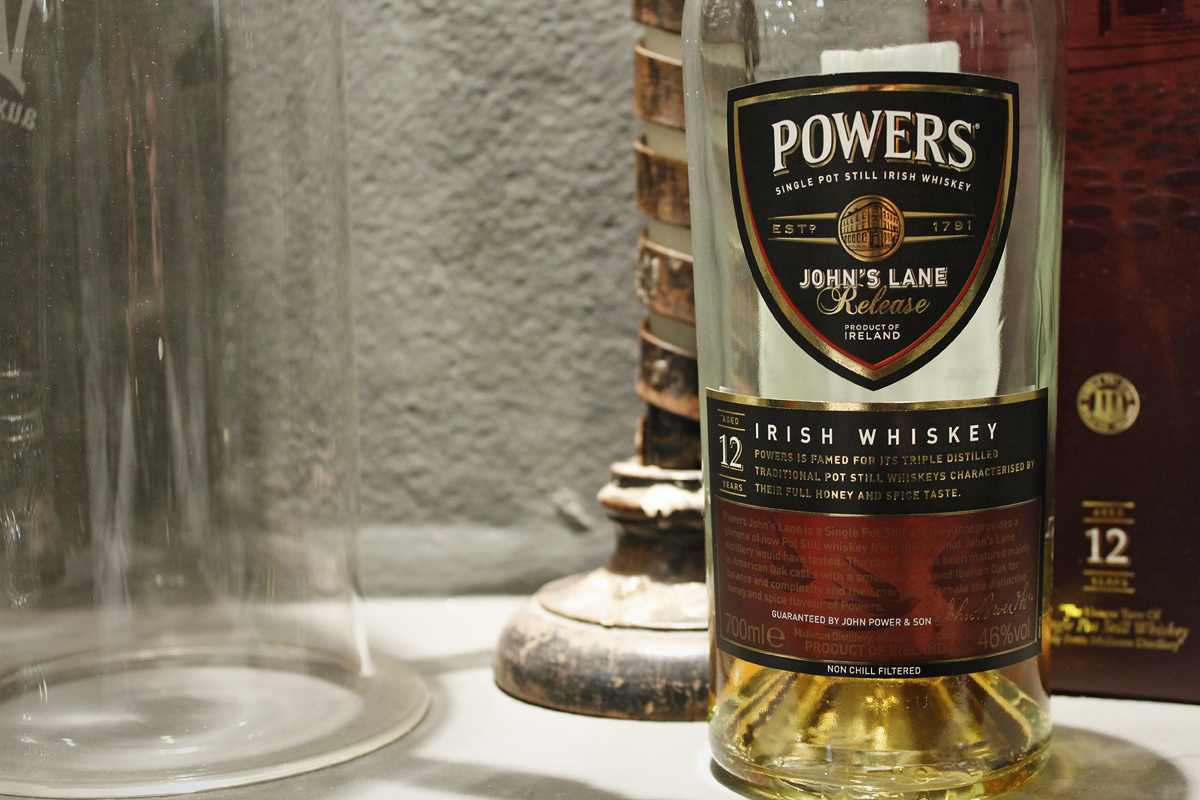
Powers John’s Lane
12 years old, 46% ABV, Bourbon & Oloroso sherry cask, single pot still, Ireland

First cab off the rank was one I’d head of, but never considered trying. Not that I have anything against Irish whiskey, but I think sometimes it can be really easy to get caught up in hype surrounding Scottish single malts and inadvertently ignore some of the other fantastic whiskies out there. Thankfully, this single pot still Irish whiskey brought that to my attention and has made sure that I wont be making that mistake again!

Powers

On the nose, this Powers was quite soft and creamy, yet fruity (in a fresh fruit salad kind of way). This was followed by some whiffs of spice (think cinnamon) and a hint of honey. A really enjoyable, delicate nose on this one for sure. The palate blows you away – coating your tongue with rich, oily fruit and big cinnamon and spice notes. This fades to a creamy vanilla and subtle sweetness on the finish. So surprising given the delicate nose!

Dave really nailed it when he simply described this one as ‘elegant’.

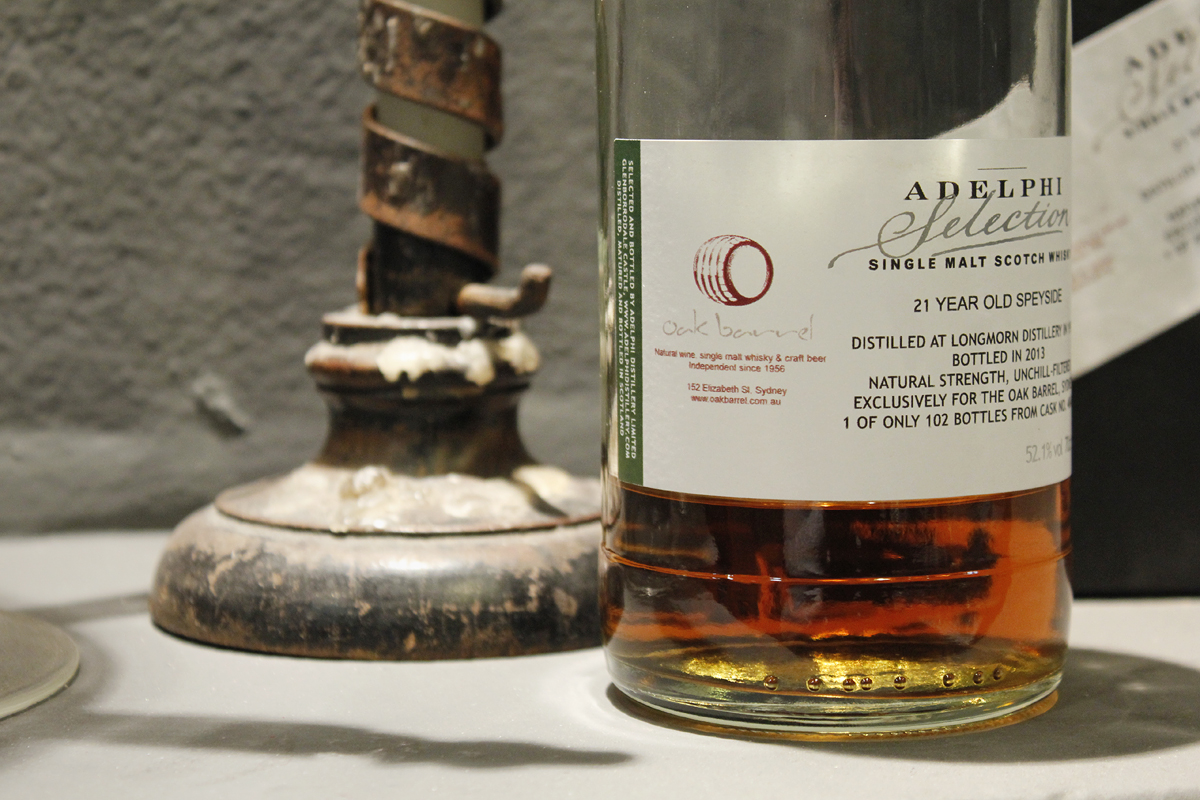
Adelphi Longmorn
1992, 21 years old, 52.4% ABV, American Oak ex-sherry cask, Oak Barrel Sydney exclusive, Scotland

Adelphi Longmorn

Adelphi are known for some of the finest independent bottlings out there and this one was no exception, bottled exclusively for the Oak Barrel in Sydney. As far as I’m aware, they’re the only bottle shop in Australia that’s had their own bottling done, so it’s pretty special!

It was a great example of an older Longmorn from the days when their stills were coal fired (ie. when some poor bloke had to shovel mounds of coal into a fire under the still to keep it running).

On the nose, the main note I got was sourness. Not in an unpleasant way, but think sour green apples in candy format crossed with apple cider vinegar and hints of toffee sweetness. I’ve never nosed a whisky like this before – really quite interesting. The nose translated to massively palate – big initial alcohol spice, followed by chewy toffee and mild oak notes fading to a creamy soft finish.

Glendronach Cask Strength
Batch 1, released 2012, NAS, 54.8% ABV, Oloroso & Pedro Ximenez cask, Scotland

Glendronach CS

Boom! (yes, I did actually write that in my whisky ledger) This has a rich nose. Think high cacao dark chocolate, rich raisins and leather. Despite a higher ABV than the Longmorn right before it, the alcohol really wasn’t that apparent on the nose. This huge nose carries through to the palate, with plenty of dark fruits and cinnamon spice.

Interestingly, Glendronach spirit is actually slightly peated to around 14 parts per million (ppm) – peat monsters like Ardbeg and Laphroaig are around 45 ppm – yet time in quality sherry casks really pulls it back and takes away that peat edge.

Heartwood Convict Redemption
Batch 1, bottle No. 72, released 2013, 12 years old, 72.5% ABV, Port cask, Australia

I guess you can think of Heartwood as an Australian independent bottler; they buy up some highest quality casks they can find then mature some of the finest Tasmanian whiskies in those casks, bottling them when they think they’re just right.

Heartwood

That ABV is not a typo (check the picture!), The Convict Redemption was indeed bottled at a humungous 72.5%. How’s that so? It turns out the angels in Tasmania are a bit different to those in Scotland and like to help themselves to a big chunk of water each year. This was originally casked at around 63%, but after 12 years of maturation it lost more water content than alcohol, resulting in this massive ABV.

Very expressive on the nose. There’s no hiding from that alcohol, but you also get some earthy notes, rich fruits from the port cask maturation and weirdly, a hint of garlic? Yes, garlic! The garlic doesn’t carry through to the palate (thankfully), but that massive ABV does, stunning your tongue and making you salivate, helping release those chewy toffee and fruit notes hiding underneath.

I must admit, this was a little bit too full-on for me, but I can understand why this is sold out and has a local cult following. I’ll definitely be keeping my eye out for future Heartwood releases.

Glendronach 1978 single cask
1978, 33 years old, Cask No. 1068, 52.9% ABV, Oloroso sherry puncheon, Scotland

Next up was the 1978 single cask Glendronach, which had me all kinds of excited.

Glendronach 1978

Look at that coca-cola colour! If I were to try and sum up the nose on this in one word, I would simply say ‘deep’. I felt like I couldn’t jam my nose deep enough into that glass, I just wanted to nose it more and more and more.

I don’t know that I ever really understood the concept of a ‘complex nose’, but after nosing this, I fell like I finally get it. The more you sniffed, the more the nose changed and the more you got out of it – and not just one scent profile. Think kiwi fruit, rich figs, dark chocolate, wet brown sugar and antique furniture – yes, you really could smell those things. Quite amazing really.

This translated to rich, yet soft palate that started off with an almond nutty-bitterness, followed by rich red winter fruit and brown sugar (minus the sweetness – if that’s possible?) You really could get lost in this whisky.

Kilchoman Loch Gorm
1st release 2013, NAS (5 years old), 46% ABV, Oloroso sherry cask, Scotland

The final whisky of the night was the recently released Kilchoman Loch Gorm. Kilchoman is the first distillery to be opened on the island of Islay on 124 years and their young whiskies have come out swinging. I first became acquainted when I met their Machir Bay and it well and truly took me by surprise. So when I heard about this new offering, matured in oloroso sherry casks for five years, before a further two months in fresh sherry casks, I couldn’t wait to try it.

Loch Gorm

I approached this expecting something like Ardbeg Uigeadail – sherry and peat – and I was way off the mark. Despite that amazingly rich sherried colour, the nose is surprisingly void of sherry notes?! Instead, I got rich peat smoke, almost bbq like with some meaty notes in there and some saltiness.

Interestingly, the sherry influence pops up and says hello when you taste it – rich sherry sweetness, smoke and tobacco flavours fading to a long, lingering wood smoke finish. This one really, really took me by surprise. The Kilchoman range is a great example of how good young whisky can be.

Overall

What a great way to round out the year. The Powers was the biggest surprise for me and I’ve no doubt I’ll add a bottle to the cabinet at some point. But the 1978 Glendronach was the highlight of the evening for me. Not because it was old, not because it was rare and not because it was expensive. But because it really was an eye-opening whisky, with so many layers and just so much going on – something you don’t encounter often and are never sure when (or if) you’ll ever encounter again.

Thanks again for your time and effort Dave. See you in 2014!

Just what the Doctor ordered

The Balvenie tasting, hosted by Dr Sam Simmons

The other week, the good folks at the Oak Barrel in Sydney  managed to secure Dr Whisky himself for a free tasting session of The Balvenie.

Who’s this Dr fellow? Sam Simmons (aka Dr. Whisky) is The Balvenie’s Global Brand Ambassador and just happened to be in Sydney for a whirlwind two-day tour that included no less than four events. Good thing he likes the stuff.

SamS

Walking in there, I think my brain naively told me ‘whisky ambassador? Must = Scotsman’, so I did a bit of a double-take when Sam spoke and I realized he’s actually a Canuk – and a genuinely funny and down-to-earth one at that!

The informal atmosphere of the Oak Barrel really lent itself to some great discussion and banter and both Sam and James (from William Grant & Sons) were genuinely knowledgeable, good sports. Bravo Balvenie, bravo!

What the Doctor prescribed

Lineup

First up was The Balvenie 15 year old Single Barrel, (cask #10786 bottle #317 for the boffins out there) and as expected, it was on form. Big Balvenie honey and toasted vanilla notes with a hint of banana on the nose. Creamy on the palate with that wonderfully feisty, warming finish that comes with the higher ABV of 47.8%.

This was followed by the (new to Australia) 17 year old double-wood, which has spent 17 years in American Oak (aka ex-bourbon) barrels, followed by around nine months in European Oak ex-sherry casks. The 17 really comes across as a richer, more succinct version of the classic 12 year old double-wood and the extra 3% ABV (it’s bottled at 43%) is a lovely touch.

Rounding out the trio was the decadent 21 year old Port Wood. This expression starts life in American Oak, before being transferred to ex-port pipes for around four months. In the scheme of 21 years, four months doesn’t sound like a long time, but we’re told that the pipes are saturated with a vatting of some of the finest vintage port out there (~30 year old port, I believe) The richness and depth is fantastic, especially for a 40% ABV bottling. You get the classic Balvenie honey and creaminess mixed with wonderful rich, red-fruit notes and some chewy oak.

Really hoping I get the chance to review each of these in a bit more detail at a later date.

That wasn’t all though

As if that wasn’t enough for a Friday arvo tasting, there was still one more surprise in store. Sam was kind enough to bring along a 40 year old cask strength Balvenie, hand-filled by The Balvenie’s master distiller himself, Mr David Stewart. This was a money-can’t-buy whisky, so it was pretty special indeed.

1973

After four decades in European Oak casks, the ‘73 had taken on an amazing mahogany colour and had a rich, full nose to match. At a natural strength of 55.2%, it was a heavy hitter, but still perfectly drammable (is that even a word?) without the need for water. It was incredibly complex and not overly oaked, which was quite a surprise considering how long it had spent in a cask. A seriously stunning whisky.

What’s remarkable is that despite the four different finishes and four different ages, you could really tell that these were all Balvenie. That marvelous creamy honeyed character really carried through all four expressions in its own way.

No doubt Sam’s schedule would have been pretty exhausting, but he still made time for everyone and didn’t miss a beat. A big thank you is in order for Sam and William Grant & Sons for their time and to the Oak Barrel, for hosting a thoroughly enjoyable and accessible tasting.