Bar White Oak

by Whisky + Alement

If you happen to follow me on Instagram (@whiskyledger), you may have noticed that I recently visited Japan. My trip was an incredible experience for a number of reasons, but right up there at the top of that list would have to be the incredible whisky bars. We simply don’t anything quite like them in Australia.

Bar White Oak 1

Well, if there is one bar here that comes terribly close, without a shadow of a doubt, it would have to be Melbourne’s Whisky + Alement. These guys just do everything right in my opinion. From the bar you can comfortably perch yourself at, to the knowledgeable and friendly bartenders to the ever-changing back bar of over 600 bottles. For a genuine whisky-lover, this place just nails it. As if there weren’t enough reasons to love them already, they’ve just gone ahead and given us another one. Bar White Oak.

Bar White Oak 5

Bar White Oak

Owners Brooke and Jules and one of their bartenders, Kelvin, were avid Japanese whisky fans well before Japanese whisky became the cool kid on the block. Between them, this love of Japanese whisky has led them to curate one of the most impressive collections you’re ever likely to see. Given the craziness over all things Japanese whisky at the moment they could no doubt flip these bottles at auction for an eye-watering price, but that’s what separates whisky collectors or speculators from people like Brooke, Jules and Kelvin.

Bar White Oak 2

They bought these bottles with the sole intention of drinking them and have decided that now’s the right time to pop the corks. On top of that, they want whisky fans to join in on the experience as well. Enter; Bar White Oak – a consumable exhibition – inside Whisky + Alement.

Bar White Oak 4

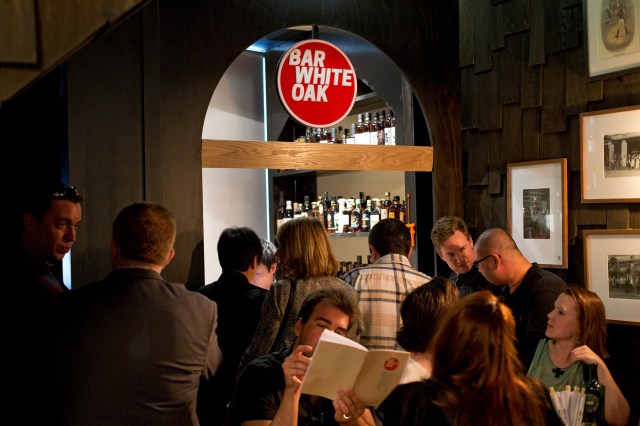
Filling the tiny space in the front window of the bar, the Bar White Oak pop-up is a dark corner of awesomeness. The timber archway draws you into the large phone-booth sized nook, lined on both sides with around 150 different Japanese whiskies – the vast majority of which you won’t be able to find anywhere else in the country. There’s everything from old blends to entry level drams and a considerable range of true hero bottles like single cask Yamazakis, Karuizawas. You’ll also find award winners like the Yamazaki Sherry Cask. Pretty much every Japanese distillery is represented, including ones you’ve probably never heard of. Everything’s available by the full or half pour and everything is there to be opened, and more importantly, enjoyed.

Bar White Oak 7

SMWS member’s preview

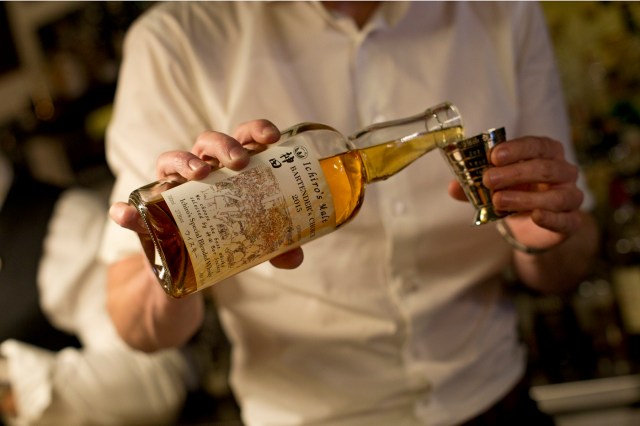
Whisky + Alement also happens to be an official partner bar of the Scotch Malt Whisky Society (SMWS) and through this partnership, SMWS members were offered and exclusive preview of Bar White Oak the other night. Two exclusive Japanese drams were poured on arrival; a rare cask strength Ichiro’s blend and an SMWS single sherry cask Miyagikyo. They were matched with some excellent sushi, great conversation and the chance to be the first soul to crack open any of the Japanese whiskies on the back bar. Yes, this was a Japanese whisky fan’s dream come true!

Bar White Oak 6

What you need to know

Bar White Oak is now officially open and will run for six months. The bar will feature a rotation of Japanese whisky, with approximately 150 different Japanese bottles on the bar at all times. That’s more than any other bar in the country. Heck, even the best-stocked whisky bars in Japan don’t have that much Japanese whisky on offer. Seriously!

Bar White Oak
270 Russell Street, Melbourne VIC

Sunday & Monday – 4.30pm to 11pm
Tuesday to Friday – 4.30pm to 12.30am
Saturday – 7.00pm to 12.30am

Bar White Oak 3

A special thanks goes to the Scotch Malt Whisky Society and Whisky + Alement for the invitation to the preview night. I guarantee you’ll be seeing me again at Bar White Oak.

Teeling 15 year old Revival

Just over a year ago now I had my first encounter with Teeling Whiskey in the form of the Small Batch and Single Grain expressions. I was genuinely surprised by both of them; I was amazed that entry-level, highly affordable expressions could taste that great. A combination that I think I’m still yet to come across with Scotch whisky. This time though I’m taking a look at something from Teeling that’s a little higher up in their range, the new 15 year old Teeling Revival.

Teeling 15 year old Revival

Having recently opened their new distillery and once again brought the art of distilling back to Dublin, the Teeling Whiskey Company decided to mark the occasion by releasing something a little bit special. To quote Jack Teeling, founder of the Teeling Whiskey Company “The opening of our new distillery was a major milestone in the history of Teeling Whiskey. It took three years of planning, hard work and significant capital investment, but now Teeling Whiskey is finally home”.

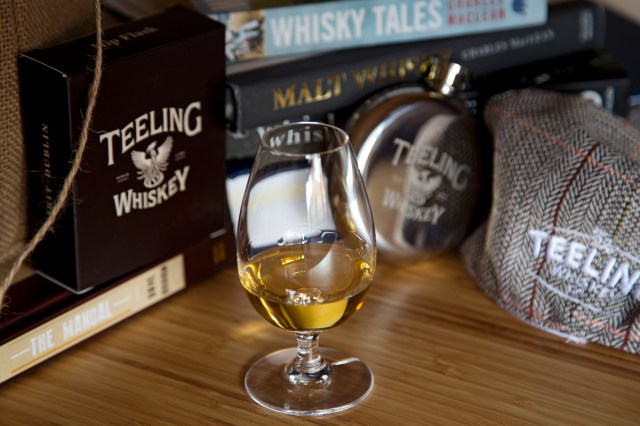
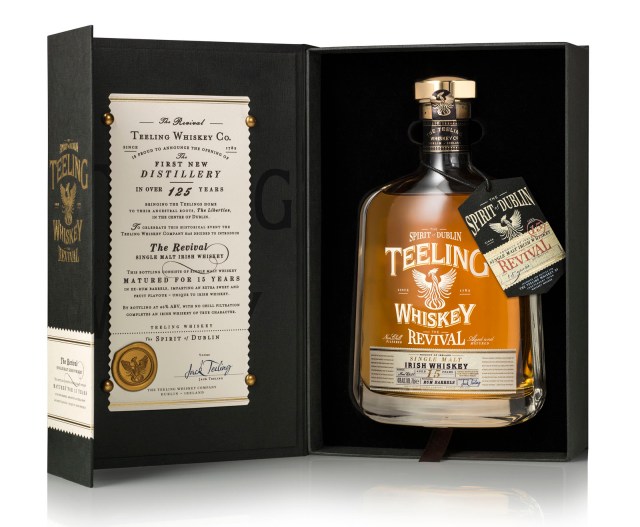
Enter the Teeling 15 year old Revival. Distilled in 1999, The 15 year old Teeling Revival has been exclusively matured in ex-Rum casks and bottled at 46% ABV, with no chill filtering.

Teeling

Tasting notes

On the nose I immediately got notes of fresh cut grass and cereal grains, layered with a slightly drying, astringent note – plastic or acetone perhaps? Thankfully those notes settle and dissipate after a short while in the glass revealing a pleasant honeyed sweetness with plenty of under-ripe fruit salad notes (rockmelon, honeydew, green banana, peach lollies and tropical fruit juice). More air reveals a nicely integrated earthy note, something I’d liken to damp moss. It’s quite a complex nose, one that benefits greatly from air in my opinion.

The palate has a really nice delivery of fruity sweetness and spice, wrapped up in a medium oily mouth feel. I feel like the word ‘juicy’ is a good descriptor here. The honeyed sweetness presents upfront along with grapefruit, mango, pawpaw, fading to reveal a tempered spice on the edges of your tongue. Its nicely balanced and integrated though helping to add character, rather than detract from it. The finish is reasonably lengthy, keeping the tropical and sour fruit notes for a good amount of time, before turning slightly vanillic and tannic toward the end. Over-steeped jasmine tea comes to mind.

Teeling Whiskey Revival

The presentation of this is whiskey is pretty special. The packaging features an incredibly solid decanter-style bottle, phat brass-colour stopper and heavy card presentation box bearing plenty of gold embossing and even a wax seal on the inner lid. Whilst none of that has any bearing on the taste, I can’t recall any other Irish Whiskeys on the market at the moment –  especially in this price bracket – that are presented anywhere near as smart as this.

The Teeling 15 year old Revival is available in Australia now at a recommended retail price of AU $159.99. Thanks goes to Martin and the good folks at Teeling for the sample reviewed here.

Compass Box Flaming Heart and This is Not a Luxury Whisky

You may not be overly familiar with John Glaser and his company Compass Box whisky, especially if you’re reading this in Australia (as distribution is rather limited here). But I feel like you should be and here’s why.

Compass Box and their whisky philosophy

Compass Box are what you could broadly describe as an independent bottler of whisky. What I mean by that is that they don’t actually distil their own whisky, rather they acquire whisky from other, established distilleries then bottle it under their Compass Box brand. Well, that’s how most independent bottlers work, but in the case of Compass Box I’ve just oversimplified it by a fairly big margin.

CB1

A good deal of the independent bottlers out there cater to the segment of the market that enjoy single cask whiskies. They literally get a cask, fill as many bottles as they can, then sell it as is. When it comes to Compass Box though, rather than simply describe them as an independent bottler, the term ‘whisky maker’ is perhaps a better descriptor. Whilst they don’t distil their own whisky, they don’t just ‘bottle’ whisky either. They like to create.

John Glaser and his team have built their reputation on the back of creating some exceptional blended whisky. Add to that their brilliant packaging design and you’ve got a pretty unique product. Another aspect that sets them apart from many others in the industry is that they’re quite happy to actually disclose what goes into their revered blends. If it’s got some 30 year old Caol Ila blended in there, they’ll tell you. Likewise, if the blend contains 12% 8 year old Glen Ord, they’ll also tell you.

The Scotch Whisky Transparency Campaign

Well, that’s what they used to do (and that’s what they’d still like to do), but that recently got them into a bit of hot water with the Scotch Whisky Association (SWA), the governing body of the Scotch whisky industry. Why? Well, the SWA’s guidelines actually prohibit this level of transparency. Sounds a tad crazy, doesn’t it?

This brings me to another reason why I believe you should familiarise yourself with Compass Box. Rather than sit back and live with the SWA’s decision, they’ve decided to do something about it. I’ll let John Glaser do the explaining.

The good people at Bruichladdich were the first to put their hand up and say, ‘yep, we support you!’ Soon after, independent bottler the Boutique-y Whisky Company announced that they would start adding age statements to all of their bottles as well, so it looks like Compass Box aren’t the only ones who believe in transparency.

As John says in the clip, if you think whisky produces should have the option (but not necessarily the obligation) to tell you all about the whisky in your bottle, head on over to the Compass Box website and lend your support.

Compass Box: The whisky

Just in case I haven’t given you enough of my opinion for one post, how about some thoughts on two of their latest releases, the Compass Box Flaming Heart 5th Edition and This Is Not A Luxury Whisky (one of the coolest whisky names in recent times in my opinion!)

Compass Box Flaming Heart 5th Edition

This is actually a fifteenth-anniversary bottling of Flaming Heart and at it’s heart, it’s comprised of 38.5% 14-year-old Caol Ila, 27.1% 30-year-old Caol Ila, 24.1% 20-year old Clynelish and 10.3% seven-year-old blended malt. That blended malt, inside this blended malt is made up of whisky from Clynelish, Teaninich and Dailuaine. How’s that for transparency!

CB3

My first reaction on nosing this one was ‘Ahhh!’. Lots of sweet and dry sooty ash notes. There’s a hint of salty sea spray and some waxy honeycomb notes with a hint of vanilla notes. It’s fairly bright and punchy, but quite well balanced.

Lots of medicinal mossy peat on the palate. I didn’t get much in the way of smoke, but there’s a fair salty tang with a lemon rind/ herbal bitterness and some damp soot. To me, it tasted a lot more mature and older than it nosed.

Compass Box This Is Not A Luxury Whisky

Such a great name. I actually think this is a luxury whisky, but not in the collectable, put it on a shelf and stare at it sense. If that’s what you’re doing with this bottle then I’m sorry, but you’re totally missing the point. No doubt the bottle looks pretty sweet, but the contents, now that’s where the fun really is!

Again, thanks to Compass Box’s transparency, we also know what’s in this one. 79% of the liquid is 19-year-old Glen Ord aged in first-fill sherry butts. 18% is 40-year-old-grain whisky from Strathclyde and Girvan and some 30-year-old Caol Ila (4%) has been blended in there as well.

CB2a

The nose is quite dense and closed, even with some airtime. I got notes of cereal grains (coconutty?), old leather, polished timber, fragrant dried flowers and some cedar wood spice. Given some time, more tropical fruit notes (think pawpaw, papaya and green banana skins) and faint honeycomb sweetness. There’s a mossy peat note in the back there too. Quite a complex nose, one that’s hard to pin down (the power of clever blending!)

On the palate it’s much more lively. Loads of those tropical fruit notes from the nose, some juicy vanilla, spice, honeycomb sweetness and oak. The faint peat notes make it almost meaty and mossy toward the finish, where a lot more of the oak comes out.

Compass Box in Australia

The good news for Australian Compass Box fans is that both of these expressions will go on sale here in the very near future. The bad news is that only a minuscule number of bottles are being brought into the country, so if you want one, start making friends with your flagship Dan Murphy’s store now. And if you want to see more of these here, follow the lead of Compass Box, be a little bit vocal (in a nice way, of course) and let your local store know.


Glenmorangie Milsean

A review of Glenmorangie’s latest Private Edition

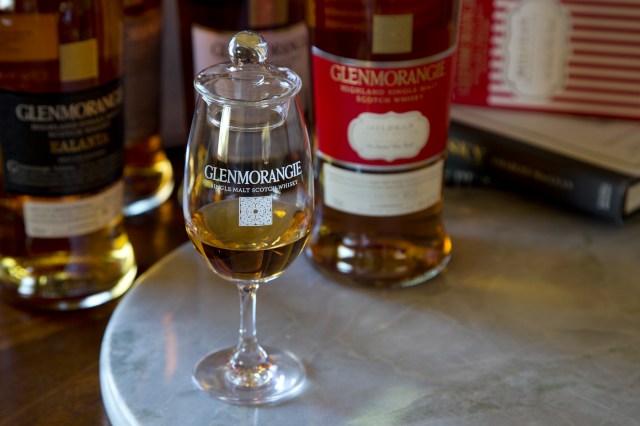
It’s that time of year again when Dr Bill Lumsden raises the curtain on Glenmorangie’s latest Private Edition expression. In it’s seventh year now, the Private Edition collection is Dr Bill’s chance to play with parts of the whisky production process and showcase the versatility of Glenmorangie’s spirit.

Milsean1

Last year he brought us the Tusail, Dr Bill’s vision of an old-school Glenmorangie made with Maris Otter barley that rose to popularity in the brewing industry in late 60s/early 70s. Prior to that we’ve seen Glenmorangie made with lightly peated barley (Finealta), Glenmorangie matured in a host of different ex-wine casks (Artein, Companta) and even a 19 year old expression (Ealanta). And in terms of coming up with yet another crazy concoction, this year’s release is no different!

Milsean explained

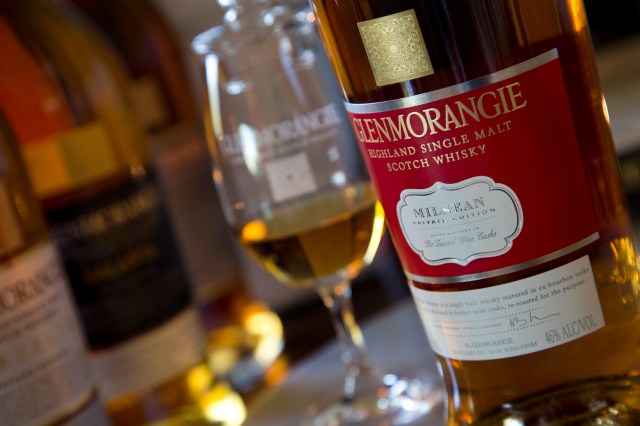
The Milsean (‘meel-shawn’ – Gaelic for ‘sweet things’) starts life as regular Glenmorangie spirit matured in ex-bourbon casks for 10 years, before being further matured in ex-wine casks for an extra two and a half years. So whilst it doesn’t carry an age statement on the label, you can do the math on this one!

Milsean4

The ex-wine casks in question are former red wine casks from Portugal that have been re-toasted specifically for this whisky. If you’re not familiar with the process of toasting, it involves heating the wood (in this case, with a direct flame) to scorch or lightly char the inside of the barrel. This process re-invigorates the cask and caramelizes both the natural sugars in the wood and those in the wine residue left behind. The result? Some super sweet toasty goodness, ready to impart bucket-loads of flavor into the Glenmorangie stored within.

Milsean: Tasted

The name Milsean translates to ‘sweet-things’ and the candy-striped packaging conjures up images of an old-school sweets shop, so I’m expecting this to be, well, pretty darn sweet. So is it?

Milsean2

Very first impression on the nose? This thing is sweet. Confectionary sweet. Dig a little deeper though and its oh so rewarding. It instantly reminded me of a freshly opened bag of marshmallows, toffee nut brittle, gummy bears, sweet macerated berries and a hint of hot chocolate powder. There’s loads of creamy vanilla that reminds me of custard powder – the kind mum used to use when we were kids.

On the palate it’s got that classic Glenmorangie backbone you find in the ten year old, but it’s layered with an oily sweetness you definitely do not find in the ten year old. Oily chewy wine gum notes, honey, candied orange peel (including that bitter pith) and super ripe sugary plums. It’s followed by a fair whack of drying spicy oak on the finish, but I feel as though it’s accentuated by the preceding sweetness, which seems to linger into the finish as well.

Milsean5

Australia has received an allocation of 200 cases of Glenmorangie Milsean and it’s available right now in both specialty retailers and through Moet-Hennesy Collection at a retail price of $150. If you – like I – have a bit of a sweet-tooth when it comes to whisky, I have a feeling this will be right up your alley.

Thanks goes to both Moet-Hennessy Australia and the great people at EVH PR for providing the bottle reviewed here.

Paul John Whisky

Indian single malt whisky

If you played a little word association game with the average person and asked ‘what’s the first country you think of when you hear the word whisky?, I’d say there’s a really good chance most people would say Scotland. Some might hit you with Ireland or the United States. Heck, Japan is probably high up on that list these days too! But I don’t think you’d get too many people saying ‘India’.
Paul John Whisky 4

Don’t for one second think that’s because India isn’t a whisky-drinking nation though. It’s quite the opposite actually. According to these statistics, India is actually the biggest whisky-drinking nation on earth! To satisfy that demand they have over 40 whisky-producing distilleries around the country, but only two of those (as far as I’m aware) produce whisky specifically for the export market. The first, and perhaps the more well-known, is Amrut and the second – the feature of this post – is Paul John.

Paul John and John Distilleries

The brand Paul John comes out of John Distilleries’ single malt distillery located in Goa. The facility uses two Indian-made copper pot stills to produce in the region of 3,000 litres of spirit daily (1.1 million litres a year). This makes them similar in scale to a distillery like Ardbeg, who also have a single set of stills and a similar annual production capacity.

Not only does Paul John use Indian-made copper pot stills, but they also use a varietal of Himalayan 6-row Indian barely in the production of their spirit. This gives them a lower alcoholic yield, but Master distiller Michael John is of the belief that it helps give the whisky more characteristics of its country of origin. Casks are filled at 55% ABV (compared to standard Scottish filling of 63.5% ABV) before being matured in one of two warehouses.
Paul John Whisky 7

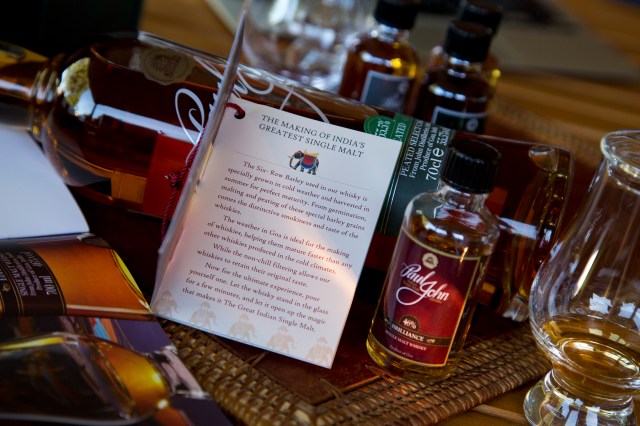
India’s hot and often humid climate makes whisky mature much faster than it would in Europe or the United States, with Paul John’s annual evaporation (‘The Angel’s Share’) being around 8% per year (compared to Scotland where it’s closer to 2%). As a result, their whiskies are often bottled anywhere between four and seven years of maturation. Paul John isn’t a brand you encounter too often here in Australia, so when they recently contacted me and offered a samples of their full core range I was more than eager to give it a try.

I’ll keep my notes brief, picking out some similarities and differences to try and form a better understanding of Paul John’s single malt profile and how the expressions compare against one another. One thing to note from the get-go is that all of their whisky is 100% natural colour and non-chill filtered.

Paul John Brilliance 46% ABV

The entry level expression in their range. Brilliance is made with un-peated spirit and is aged in ex-Bourbon American Oak casks for around 4 years.

Quite soft on the nose with some sweet vanilla and malty biscuit notes. There’s a hint of citrus, orange pith and oak. It’s chewy and oily on the palate and quite close to the nose – more citrus, zesty notes, spice and oak. It’s like a quality, soft Speyside whisky.

Paul John Whisky 6

Paul John Edited 46% ABV

Edited is also matured in ex-Bourbon American Oak casks for around 4 years, however it contains around 15-20% of peated spirit in the vatting. To get peated spirit, Paul John import peat from Scotland and then peat their preferred 6-row Indian barley themselves.

Very soft again on the nose, almost muted in a way. There’s a definite hint of peat that presents itself in a salty, damp hay smoke kind of way. It’s there, but it’s also fairly subtle and integrated. I still get the same malty biscuit and citrus notes from the Brilliance as well.

On the palate the peat is quite pronounced upfront with a salty saline tang, that great chewy mouthfeel. There’s toffee, maybe even salted caramels and that bitter citrus pith note again.

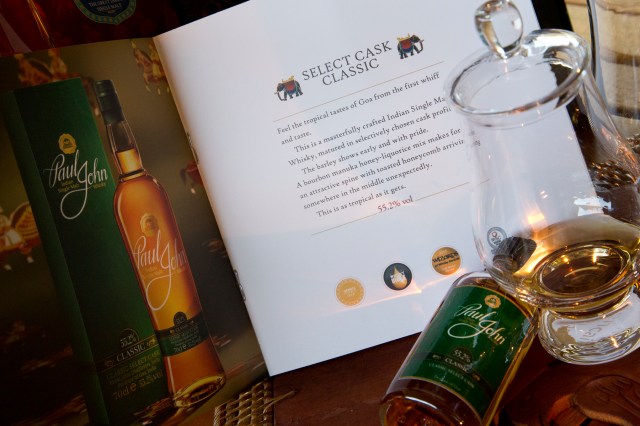
Paul John Classic Select Casks 55.2% ABV

A non-peated cask strength offering. A fuller, deeper and richer nose compared with the Brilliance, really showcasing the oily rich spirit profile. I got deep creamy vanilla, sweet malty cake notes and a hint of orange.

It’s bright and punchy upfront on the palate with a great sweet, oily, malty mouthfeel. Hot cinnamon and cedar-wood spice upfront gives way to sweet chewy vanilla, some honey notes, summer fruit salad. There’s more malt, oak and spice on the finish.

There’s a definitely lineage to the Brilliance in this one – with a similar general profile – but everything is cranked up to 11 and there seems to be more going on in the Classic Select Cask, probably due in part to the higher alcohol level.
Paul John Whisky 8

Paul John Bold 46% ABV 

The ‘Bold’ expression takes us into full peated territory and a single small whiff confirms that. It’s quite deep and bold on the nose with sweet herbal peat notes. It’s quite vegetal though, like a highland peated whisky, with a salty saline tang.

It’s vegetal and peaty on the palate (though not smoky) with that saline tang from the nose, but it also manages to incorporate some sweet notes. It finishes with a big wave of lingering peat that dries out your tongue, leaving behind a slightly bitter oaky woodiness.

Paul John Peated 55.5% ABV

As the name suggests, this takes us into peated territory again, but this time at cask strength. It somehow seems more restrained on the nose, with a nice balance of peat, berry/sherry sweetness and that herbal salty peat note.

Loads of tangy, salty peat upfront on the palate, a hint of crisp drying smoke, vanilla, charred peaches and brown sugar sweetness. The higher ABV carries the peat notes through to a long satisfying finish.

Paul John Whisky 3a

Some overall thoughts

I was really impressed by the whole Paul John range. Not that I expected it to not be good, but I think in the back of my mind I didn’t expect it to taste anywhere near as mature and balanced as it does. None of these five expressions gave off any hint of their youth. The decision to bottle at 46% ABV and above with no chill filtering is a smart move in my opinion, with the full range having a fantastic oily, chewy mouthfeel that carries loads of flavour across the palate. Whilst some of the expressions are slightly restrained in their flavour profile, they were all nicely balanced and tasted like high quality, well-made whisky to me. If I had to pick a favourite out of the five, I think I’d go for the ‘Peated’ expression at cask strength. It had a lot going on in every sip and is genuinely great whisky.
Paul John Whisky 5

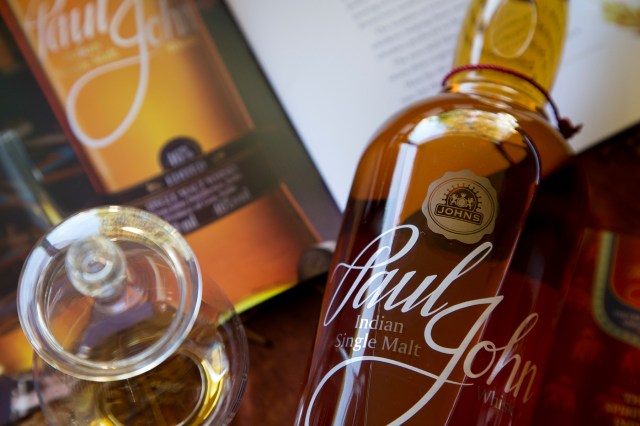
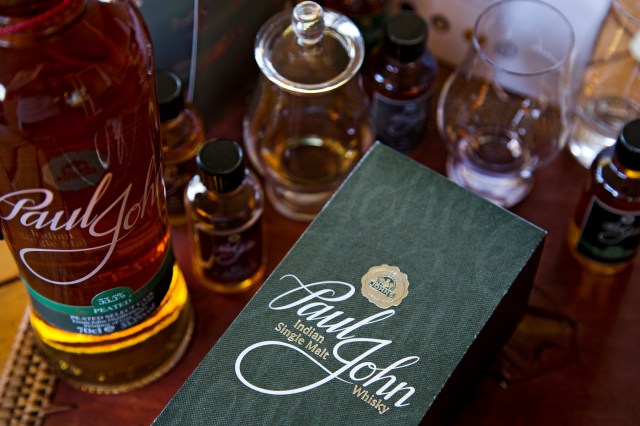
Paul John also kindly included a full-size bottle for me to photograph (pictured throughout this post). I’m a sucker for packaging and presentation and I have to say, the presentation is rather smart! An embossed card box with a magnetic closure opens to reveal a nice clean, modern bottle. The fonts/script used throughout are fresh and clean, the main branding is screen-printed and there’s a nice little swing tag including a booklet on all the basics you need to know about Paul John’s full range.

Paul John Whisky in Sydney 

Mr Madhu Kanna, General Manager – Exports, from Paul John will be in Australia for the Whisky Live whisky show on 8th and 9th April 2016 so if you’ve got yourself a ticket, I encourage you to drop by their stand and try some Paul John whiskies for yourself!

Paul John Whisky 1

Thanks goes to Paul John for the generous whisky samples. I’m looking forward to seeing your brand develop further and tasting whatever you bring out next!