Aberlour 16 year old double cask

16 years old, 43% ABV, Oloroso and American Oak casks, Speyside, Scotland

The Aberlour distillery is nestled away in the Speyside region of Scotland in the town of Aberlour – a couple of minutes down the road from Craigellachie.
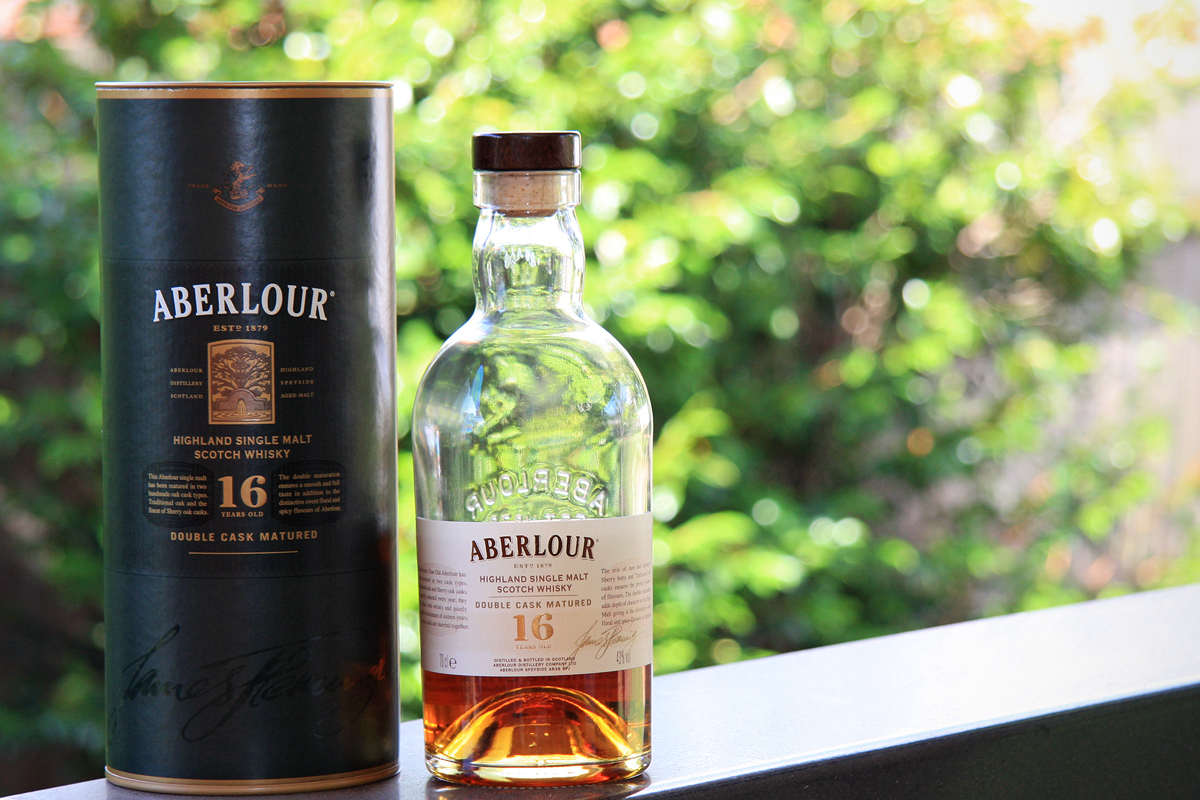
Aberlour 16

Interestingly though, on the package of the 16 year old double cask, Aberlour refer to themselves as both a Highland and Speyside distillery.
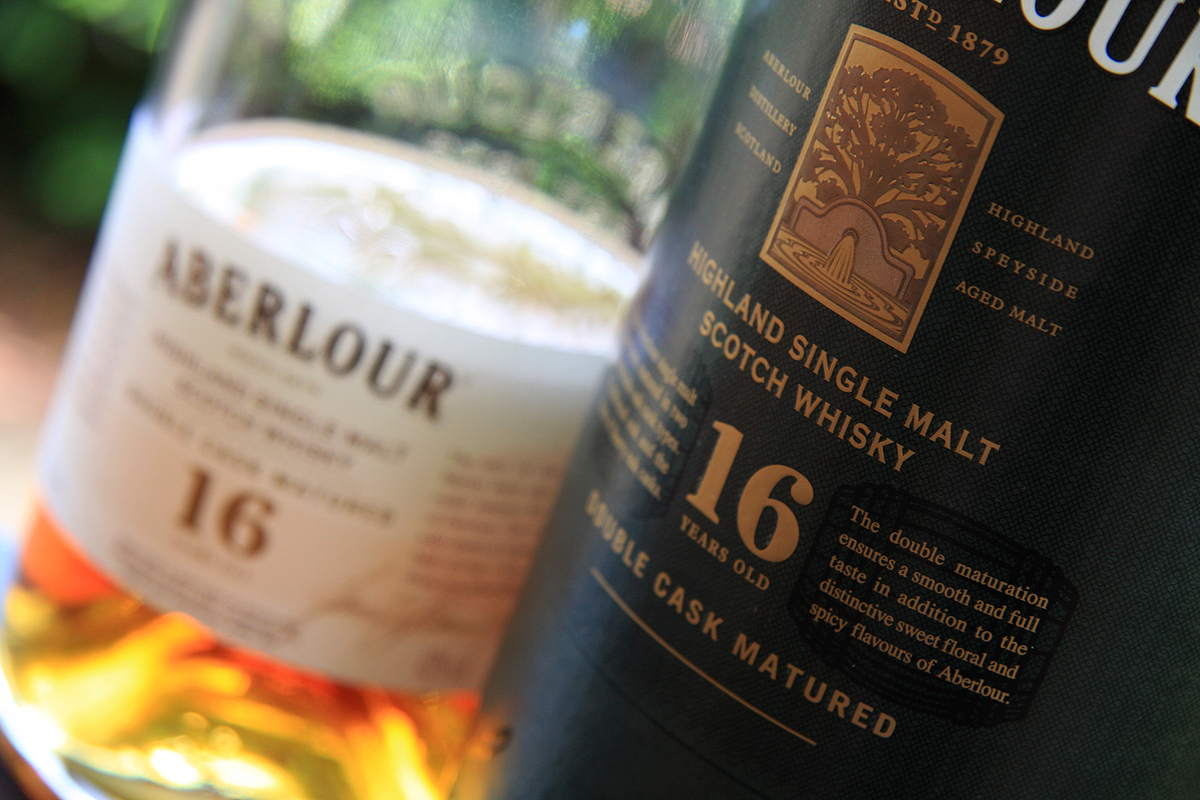
Aberlour 16 tube

The bright copper-coloured 16 year old double cask pictured here is a marriage of two different whiskies.

Aberlour take a whisky that’s been maturing for at least 16 years in first-fill Oloroso sherry casks and a whisky that’s been maturing for at least 16 years in first-fill American Oak. The two are then married together for a period of around three months in a marrying tun before being bottled as the 16 year old double cask.

Aberlour 16 seal

Just as you’re about to open the bottle for the first time, you’re met with this little paper seal scribed with a simple description of what you’re about to taste. I think it’s a nice little touch. (In case you’re wondering, the liquid inside does indeed live up to the description – read on)

Did you know…

The town of Aberlour is also the home of Walker’s Shortbread. I don’t know about your part of the world, but at home in Sydney, there always seemed to be a tin or box of Walker’s Shortbread in our house around Christmas time. Might have to pair one with a dram of Aberlour 16 to see how it goes!

Nose

Initially quite fresh and floral – notes of soft vanilla, light spice, green apples, citrus and gentle sweetness. The nose sweetens after some glass/air time with some malty honey notes showing and something a bit zesty and bitter – orange marmalade comes to mind. A pretty well balanced nose in my opinion.

Palate

A nice medium oily mouth feel on entry – it has a nice weight to it for a 43% whisky. Gentle spice and sweetness come out first, followed by some of those citrus/bitter marmalade flavours. The sweetness and vanilla aren’t as strong as I would have expected from the nose, but they’re still there.  Overall, quite light and soft on the palate.

Finish

The 16 year old finishes with medium warmth and light malty sweetness contrasted with a fair bit of oaky bitter spice.

Comments

With little debate, the cask strength A’bunadh is the most well-known and talked about whisky in Aberlour’s current line up. But I think this is a really underrated gem and one that’s definitely worth exploring.

If A’bunadh is the heavyweight bigger brother packed with boisterous pointed flavours, then the 16 year old double cask is its nimbler sibling with rounder, softer, more harmonious flavours. A well-made high quality whisky at a pretty good price point.

If you’re a fan of A’bunadh and have been wondering about the other offerings in the Aberlour stable – maybe it’s time you gave the 16 year old double cask a go.

As a random side note, this bottle has to have the best sealing cork I’ve come across!

Glenmorangie Quinta Ruban

12 years old, 46% ABV, American Oak and Ruby port pipes, Northern Highlands, Scotland

Around 2008, Glenmorangie released what we now know as the current range of  ‘extra-matured’ whiskies. The range of three includes Lassanta (finished in ex- oloroso sherry casks), Nectar d’Or (finished in sweet French sauternes wines casks) and this one, Quinta Ruban which has been finished in Portuguese ruby port pipes.

Quinta Ruban

To arrive at these ‘extra-matured’ whiskies, Glenmorangie start with their standard 10 year old, which has been resting away for ten years in American white oak (first fill and refill casks).

They re-rack this whisky into the wine casks mentioned above for a further two years of maturation, bottling each expression at 12 years of age. The other big difference between the extra-matured range and the standard 10 year old is that they’re each bottled at 46% ABV (instead of 40%). They’re also non-chill filtered – preserving loads more of those delicious oily flavours.

Quinta Ruban label

Did you know…

Glenmorangie have long been considered one of the pioneers of cask finished or ‘extra-matured’ whisky. Well before the current extra-matured range was released, Glenmorangie were re-racking their whisky into various wine casks, as far back as the late 1980’s. Some of these casks were pretty exotic too! Truffle Oak anyone?

Often referred to as one of their best and one that collectors regularly pay big dollars for is their 1975 Tain L’Hermitage. Distilled in 1975, it was moved into Côtes du Rhône wine casks in 1999, then bottled in 2003 at 28 years old (there was also an original version bottled in 1995, but it’s as rare as hen’s teeth).

Nose

The first thing I got was more spirit than usual, not surprising given it’s bottled at 46%. Sweet vanilla bourbon notes from the American white oak are there, but they’re dominated by a rich sweetness. Not super fruity, but more sugared plums, cherry and wine notes. I got a hint of spice and also some curious fresh/cooling notes – butter menthol of some sort?

Palate

On entry, this has a reasonably oily mouth feel and is quite sweet and creamy. I also got a fair amount of spice on the side of my tongue, but it dissipates rather quickly, leaving behind a second wave of creamy sweet plummy notes, some dark cherries and a slightly tingling raspberry jam flavour. The port has had a big influence on this one.

Finish

The spice on the palate fades as fast as it arrives, leaving behind a really curious tingling sensation, almost fizzy or carbonated in a sense. Can’t say I’ve experienced that sensation in a whisky before! Some light oaky bitterness, nice medium length warmth and some traces of that cooling butter menthol from the nose start to emerge.

Comments

Even though the port finish is pretty heavy on the nose and palate, this is still unmistakably Glenmorangie. I love the fact it’s non-chill filtered and that they’ve bottled it at 46% ABV (makes me wish the standard 10 year old was the same).

I personally found the fizzy tingling sensation a little odd and the port dominated a bit too much for my liking, taking away from the more delicate Glenmorangie notes that I really enjoy. In saying that, I can definitely see this being enjoyed by many as a great digestif style whisky.

The Glenlivet 12 year old

12 years old, 40% ABV, American and European Oak, Speyside, Scotland

When I was putting together my Christmas whisky tasting kits, I wanted to start everyone off with a really approachable, classic single malt – to provide them with something of a base line I suppose.

Realising I didn’t seem to have anything that met the criteria that well, I tracked down this little 200ml (20cl) bottle of The Glenlivet 12 year old. There happened to be a couple drams worth left after I’d put the kits together, so I thought I’d review it!

Glenlivet 12

Despite being a mini version, the bottle and label design holds true to the 700ml version of the 12 year old – just in miniature form.

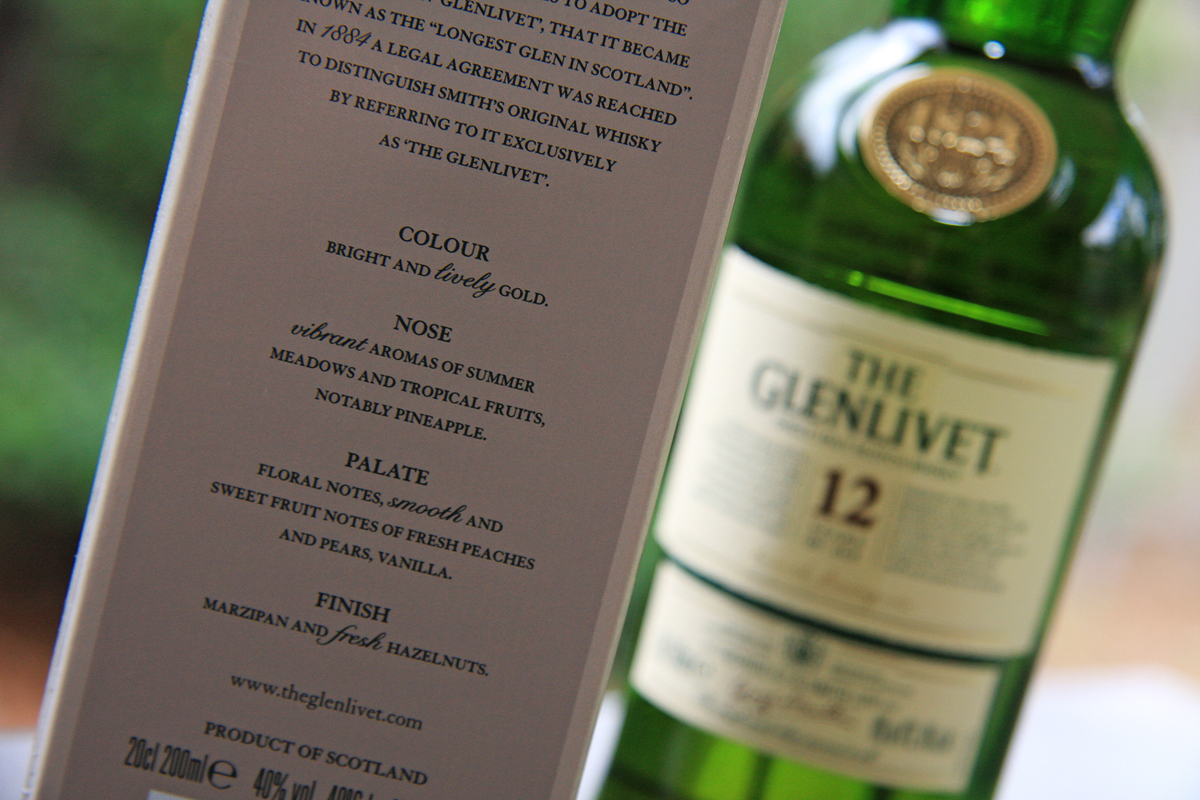
Glenlivet 12 notes

Just like the tasting notes found on the back of the 18 year old I reviewed a little earlier, there are some notes on the back of this mini box for the 12 year old. Again, I’m not sure I completely agree with all of them, but they are a nice touch and fun to compare to.

Did you  know…

In my review of the 18 year old, I mentioned that I was looking into the origins of The Glenlivet’s thistle motif. I reached out to some people that work at the distillery’s visitors centre and asked them about the origin of the thistle logo and it turns out that they’re not entirely sure why it’s there either! All I can tell you is that it appeared in the 1970’s and has been there ever since.

It does seem to be a common theme among many business names and logos in Moray (where the distillery is located), so perhaps there’s some connection there?

Nose

I got a big hit of green apples – but in an apple cider kind of way. Quite drying, with some citrus and a light sweetness.  The more I nosed this, the more I kept thinking that it reminded me of a sauvignon blanc – it’s a very delicate nose. When left to sit in the glass, the nose does sweeten up a bit and those crisp dry cider notes fall away a bit.

Palate

Quite thin feeling in the mouth, with sweet and citrusy notes immediately apparent. These were followed by some hints of vanilla and a bit of spicy bitterness – almost like citrus fruit pith.

Finish

Quite short, but also quite a pleasant finish. As the finish fades, I got some stronger vanilla notes (which were nice) and some oaky bitter spice at the front of the tongue, right towards the end.

Comments

This expression is matured in a mixture of cask types, including American and European Oak. It’s fairly one dimensional and not overly complex in flavour, but like all Glenlivet’s I’ve tasted, it’s a good quality, reliable whisky. A really pleasant, light, pre-dinner dram.

A very whisky Christmas – update

They’re finished and not a day too soon!

Whisky tasting set

Each little pack contains a Glencairn glass, a water pipette, notes and tasting instructions (written by yours truly) and six 25ml samples.

The notes start by explaining whisky basics, blends vs. single malts, how whisky’s produced, the use of peat, the different casks and what happens during maturation. Using whiskies I had on hand, I wanted to try and take each taster on a little journey and really highlight how diverse whisky can be, so I settled on the following:

  • The Glenlivet 12 year old
  • The Macallan 12 year old sherry oak
  • Aberlour 16 year old double cask
  • Glendronach 2002 10 year old single cask
  • Highland Park 12 year old
  • Laphroaig Quarter Cask.

I think there’s enough variation in there for anyone to be able to pick up on some of the differences – from the honeyed vanilla and sometimes floral notes of a bourbon cask, to the rich raisin and spice notes of European sherry oak all the way to the intense smokiness of peat. Hopefully they each find something they like!

Just what the Doctor ordered

The Balvenie tasting, hosted by Dr Sam Simmons

The other week, the good folks at the Oak Barrel in Sydney  managed to secure Dr Whisky himself for a free tasting session of The Balvenie.

Who’s this Dr fellow? Sam Simmons (aka Dr. Whisky) is The Balvenie’s Global Brand Ambassador and just happened to be in Sydney for a whirlwind two-day tour that included no less than four events. Good thing he likes the stuff.

SamS

Walking in there, I think my brain naively told me ‘whisky ambassador? Must = Scotsman’, so I did a bit of a double-take when Sam spoke and I realized he’s actually a Canuk – and a genuinely funny and down-to-earth one at that!

The informal atmosphere of the Oak Barrel really lent itself to some great discussion and banter and both Sam and James (from William Grant & Sons) were genuinely knowledgeable, good sports. Bravo Balvenie, bravo!

What the Doctor prescribed

Lineup

First up was The Balvenie 15 year old Single Barrel, (cask #10786 bottle #317 for the boffins out there) and as expected, it was on form. Big Balvenie honey and toasted vanilla notes with a hint of banana on the nose. Creamy on the palate with that wonderfully feisty, warming finish that comes with the higher ABV of 47.8%.

This was followed by the (new to Australia) 17 year old double-wood, which has spent 17 years in American Oak (aka ex-bourbon) barrels, followed by around nine months in European Oak ex-sherry casks. The 17 really comes across as a richer, more succinct version of the classic 12 year old double-wood and the extra 3% ABV (it’s bottled at 43%) is a lovely touch.

Rounding out the trio was the decadent 21 year old Port Wood. This expression starts life in American Oak, before being transferred to ex-port pipes for around four months. In the scheme of 21 years, four months doesn’t sound like a long time, but we’re told that the pipes are saturated with a vatting of some of the finest vintage port out there (~30 year old port, I believe) The richness and depth is fantastic, especially for a 40% ABV bottling. You get the classic Balvenie honey and creaminess mixed with wonderful rich, red-fruit notes and some chewy oak.

Really hoping I get the chance to review each of these in a bit more detail at a later date.

That wasn’t all though

As if that wasn’t enough for a Friday arvo tasting, there was still one more surprise in store. Sam was kind enough to bring along a 40 year old cask strength Balvenie, hand-filled by The Balvenie’s master distiller himself, Mr David Stewart. This was a money-can’t-buy whisky, so it was pretty special indeed.

1973

After four decades in European Oak casks, the ‘73 had taken on an amazing mahogany colour and had a rich, full nose to match. At a natural strength of 55.2%, it was a heavy hitter, but still perfectly drammable (is that even a word?) without the need for water. It was incredibly complex and not overly oaked, which was quite a surprise considering how long it had spent in a cask. A seriously stunning whisky.

What’s remarkable is that despite the four different finishes and four different ages, you could really tell that these were all Balvenie. That marvelous creamy honeyed character really carried through all four expressions in its own way.

No doubt Sam’s schedule would have been pretty exhausting, but he still made time for everyone and didn’t miss a beat. A big thank you is in order for Sam and William Grant & Sons for their time and to the Oak Barrel, for hosting a thoroughly enjoyable and accessible tasting.